
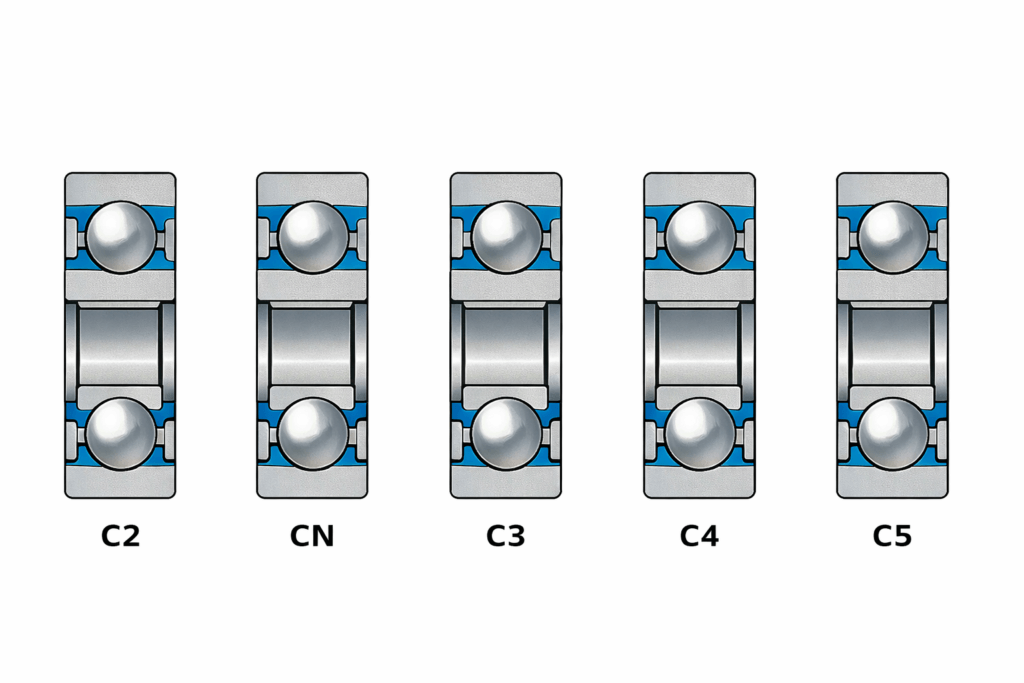
When selecting the right industrial bearing for machinery, one of the most important technical parameters to consider is bearing internal clearance. Internal clearance directly affects bearing performance, operating temperature, load distribution, speed capability, and overall service life.
In simple terms, bearing clearance refers to the amount of free movement between the rolling elements (balls or rollers) and the bearing raceways before the bearing is installed. Selecting the correct clearance class is essential for ensuring smooth operation in electric motors, pumps, compressors, gearboxes, conveyors, and other rotating equipment.
Manufacturers classify internal clearance into several standardized groups such as C2, Normal (CN), C3, C4, and C5. Each clearance class is designed for specific operating conditions, temperature levels, and load requirements.
In this guide, we will explain all bearing clearance levels and their applications to help engineers and maintenance professionals select the correct bearing for their machinery.
What is Bearing Internal Clearance?
Bearing internal clearance is the total distance one bearing ring can move relative to the other. This movement occurs either radially (perpendicular to the shaft) or axially (parallel to the shaft).
There are two primary types of internal clearance:
1. Radial Internal Clearance
Movement of the inner ring relative to the outer ring in the radial direction. This is the most commonly referenced clearance in bearing specifications.
2. Axial Internal Clearance
Movement of the rings in the axial direction along the shaft axis.
During operation, internal clearance usually decreases because of:
- Thermal expansion of bearing components
- Interference fits between shaft and housing
- Operational loads and friction
Therefore, choosing the correct bearing clearance class is critical to maintain proper performance.
C2 Clearance Bearings (Less Than Normal Clearance)
C2 clearance bearings have smaller internal clearance than standard bearings. These bearings are used in applications where high precision and reduced vibration are required.
Key Characteristics
- Smaller internal clearance than normal
- Higher rigidity and precision
- Reduced vibration during operation
Typical Applications
C2 clearance bearings are commonly used in:
- Precision machinery
- Machine tools
- High-accuracy instruments
- Electric motors with controlled fits
However, because the clearance is small, thermal expansion can easily eliminate internal clearance, which may lead to overheating if not properly designed.
Normal Clearance Bearings (CN or Standard Clearance)
Normal clearance bearings, also called standard clearance bearings, are designed for general industrial applications. They provide a balanced internal clearance suitable for typical operating temperatures, speeds, and loads.
Key Characteristics
- Standard internal clearance level
- Suitable for most machinery applications
- Balanced performance for load and speed
Typical Applications
Normal clearance bearings are widely used in:
- Conveyor systems
- Agricultural machinery
- Industrial equipment
- Household appliances
- Low to moderate speed machinery
Because of their versatility, CN clearance bearings are the most commonly used bearings in industrial equipment.
C3 Clearance Bearings (Greater Than Normal Clearance)
C3 clearance bearings have more internal clearance than standard bearings. This extra clearance helps compensate for thermal expansion, high speeds, and tight mounting fits.
Key Characteristics
- Larger internal clearance than normal
- Suitable for high-speed operation
- Helps prevent overheating in high-temperature environments
Typical Applications
C3 clearance bearings are widely used in:
- Electric motors and generators
- Industrial pumps and compressors
- Automotive gearboxes
- High-speed rotating equipment
- Industrial fans and blowers
In fact, electric motor bearings often use C3 clearance to compensate for heat generated during operation.
C4 Clearance Bearings (Higher Clearance for Extreme Conditions)
C4 clearance bearings provide even greater internal clearance than C3 bearings. They are designed for applications where high temperatures, heavy loads, or severe operating conditions are present.
Key Characteristics
- Significantly larger clearance than standard bearings
- Suitable for high thermal expansion environments
- Performs well in demanding industrial conditions
Typical Applications
C4 clearance bearings are used in:
- Steel plants and heavy industry
- Cement manufacturing equipment
- Mining machinery
- High-temperature industrial equipment
Because of the larger clearance, these bearings help prevent excessive friction caused by heat expansion.
C5 Clearance Bearings (Maximum Internal Clearance)
C5 clearance bearings offer the largest internal clearance among standard clearance classes. They are used only in extreme operating environments where significant thermal expansion occurs.
Key Characteristics
- Maximum internal clearance
- Designed for very high temperatures or heavy loads
- Suitable for specialized industrial applications
Typical Applications
C5 clearance bearings are typically found in:
- High-temperature industrial furnaces
- Heavy-duty mining equipment
- Specialized industrial machinery
Because of the large clearance, they are rarely used in general industrial applications.
Comparison of Bearing Clearance Levels
| Clearance Level | Internal Clearance | Typical Applications |
|---|---|---|
| C2 | Less than normal | Precision machinery |
| CN (Normal) | Standard clearance | General industrial equipment |
| C3 | Greater than normal | Electric motors, pumps, high-speed machines |
| C4 | Higher than C3 | Heavy industry, mining, high temperatures |
| C5 | Maximum clearance | Extreme temperature environments |
Why Bearing Clearance Matters
Selecting the correct bearing clearance level is essential for maintaining machine reliability and bearing life. Proper clearance ensures:
- Reduced friction and heat generation
- Better load distribution
- Improved high-speed performance
- Longer bearing service life
- Lower maintenance costs
Incorrect clearance selection can lead to bearing overheating, premature wear, increased vibration, and early failure.
Conclusion
Understanding bearing clearance levels such as C2, CN, C3, C4, and C5 is crucial when selecting the right bearing for industrial machinery. While normal clearance bearings (CN) work well for general applications, C3, C4, and C5 clearance bearings are specifically designed for high-speed, high-temperature, and heavy-load environments.
By choosing the appropriate clearance class, engineers can significantly improve machine performance, reliability, and durability.
To explore bearing numbers, technical specifications, and bearing dimensions, you can visit www.lntbearings.com, where users can easily search for industrial bearings and request quotes for various applications.
Note: The information presented in this article is based on secondary data sources and general industry references.
Pingback: How to Read a Bearing Number: Complete Guide (6200, 6300, 6205 Series) -