Introduction
In today’s rapidly advancing industrial landscape, precision, speed, and efficiency are no longer optional—they are essential. At the heart of this transformation lies one critical component: linear bearings.
Unlike traditional rotary bearings, linear bearings enable smooth motion in a straight line. This simple yet powerful function is revolutionizing industries ranging from manufacturing and automation to healthcare and robotics.
What Are Linear Bearings?
Linear bearings are designed to provide low-friction motion along a straight path. They are commonly used with shafts or guide rails to support and guide moving components with high accuracy.
Key Features:
- Smooth and precise linear motion
- Low friction and wear
- High load-carrying capacity
- Long service life
- Minimal maintenance
Applications of Linear Bearings
Linear bearings are becoming essential across multiple industries due to their reliability and efficiency.
Major Applications:
- CNC machines and automation systems
- Robotics and pick-and-place machines
- Packaging and printing equipment
- Medical devices and diagnostic machines
- Semiconductor manufacturing
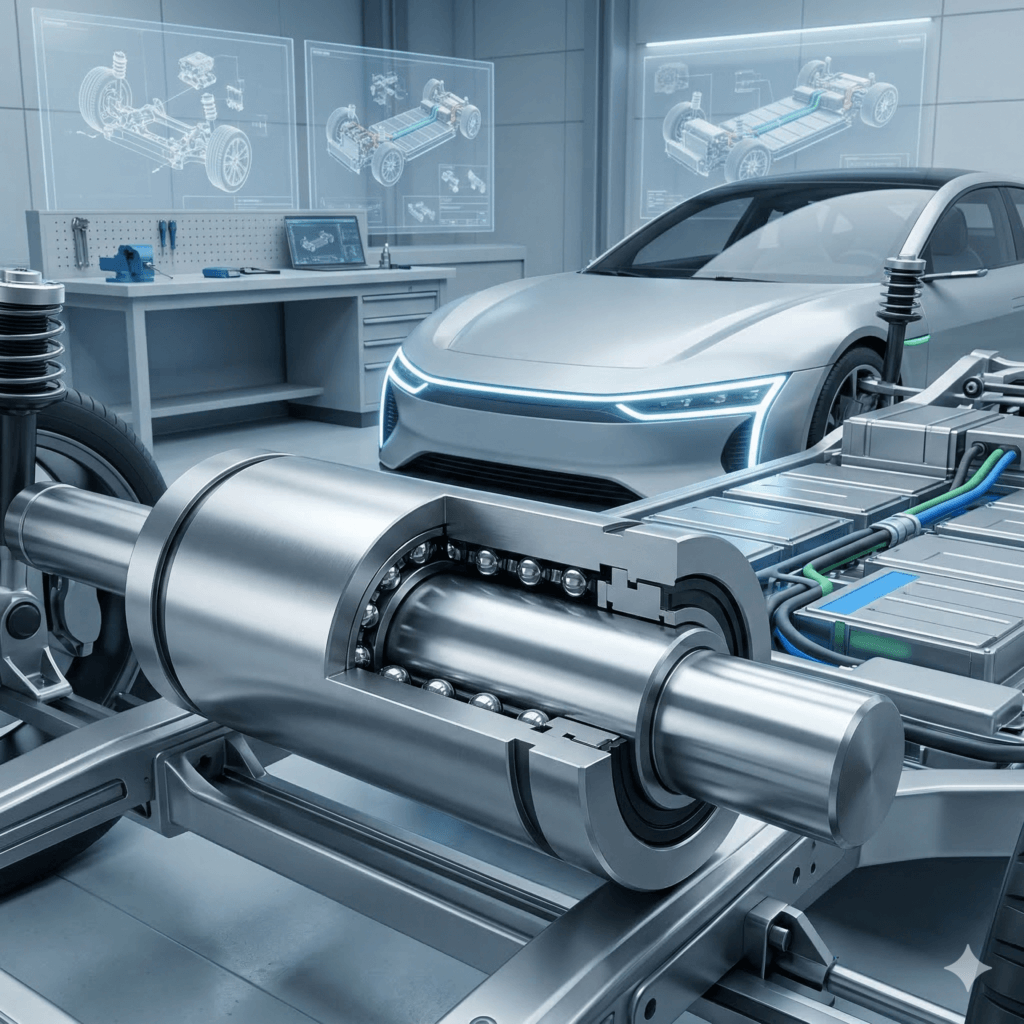
- Electric vehicles and battery assembly lines
Their ability to deliver precision and repeatability makes them indispensable in modern machinery.
Why Linear Bearings Are the Future
1️⃣ Rise of Automation
With industries rapidly shifting towards automation and smart manufacturing, linear bearings play a key role in enabling accurate and repeatable motion systems.
2️⃣ Growth of Robotics
Robots rely heavily on linear motion systems for movement and positioning. As robotics expands, so does the demand for linear bearings.
3️⃣ Electric Vehicle Revolution
EV manufacturing involves highly automated production lines where linear motion systems ensure precision assembly and efficiency.
4️⃣ Demand for High Precision
Industries such as electronics and healthcare require micron-level accuracy—something linear bearings deliver consistently.
5️⃣ Space and Efficiency Optimization
Linear systems are compact and efficient, making them ideal for modern machines where space and energy efficiency are critical.
Why Linear Bearings May Become the Most Used Bearing
The global shift towards automation, digitization, and precision engineering is driving a major transformation in mechanical systems.
Linear bearings are expected to become one of the most widely used bearing types because:
- Machines are moving from rotational to controlled linear motion
- Automated systems require guided movement rather than free rotation
- Industries demand higher efficiency and reduced downtime
- Integration with smart systems and sensors is easier
In simple terms, as machines become smarter, linear motion becomes more important than rotational motion in many applications.
Advantages Over Traditional Bearings
| Feature | Linear Bearings | Conventional Bearings |
|---|---|---|
| Motion Type | Linear | Rotational |
| Precision | Very High | Moderate |
| Automation Compatibility | Excellent | Limited |
| Maintenance | Low | Moderate |
| Efficiency | High | Medium |
Conclusion
Linear bearings are not just components—they are enablers of the future. From factory automation to advanced robotics, they are shaping the next generation of engineering solutions.
As industries continue to evolve, the demand for precision, speed, and reliability will only grow—and linear bearings will be at the center of this transformation.
📞 Get in Touch with LNT Bearings
For high-quality linear bearings and customized solutions:
🌐 Website: www.lmtbearings.com
📧 Email: info@lntindia.co.in | info@lntbearings.com
📞 Phone: 9560025418 | 9810466117