
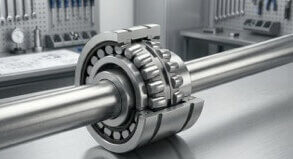
Machine tools are the foundation of modern manufacturing, producing critical components for the automotive, aerospace, medical device, and industrial machinery sectors. At the core of every high-performance machine tool is a precision-engineered bearing — the key to smooth rotation, tight tolerances, and structural rigidity under demanding cutting loads.
As global manufacturers push for higher spindle speeds, tighter machining tolerances, and greater output, the evolution of machine tool bearing technology has become a decisive factor in maintaining competitive advantage.
What Performance Standards Must Machine Tool Bearings Meet?
Unlike standard industrial bearings, high-precision machine tool bearings operate under extreme conditions — including elevated spindle speeds, fluctuating cutting forces, thermal stress, and continuous vibration. To meet these demands, they must deliver:
- Micron-level accuracy for ultra-precise machining
- High-speed capability to maximize metal removal rates
- Superior spindle rigidity to resist deflection under load
- Low friction and minimal heat generation for thermal stability
- Extended service life to reduce unplanned downtime
- Vibration and noise control for superior surface finish quality
Types of Machine Tool Bearings and Their Applications
Selecting the right bearing type for machine tools depends on the specific function — spindle, feed axis, or rotary table.
| Location | Bearing Type | Key Advantage |
|---|---|---|
| Main Spindle | Angular contact ball bearings, cylindrical roller bearings, hybrid ceramic bearings | High-speed performance, stiffness, thermal control |
| Feed Axes | Linear guide bearings, precision ball screw thrust bearings | Smooth linear motion, positioning accuracy |
| Rotary Tables / Indexers | Cross-roller bearings, tapered roller bearings, slewing ring bearings | High load capacity, rotational precision |
Hybrid ceramic angular contact bearings have become the top choice for CNC spindle applications, offering lightweight construction, electrical insulation, and exceptional speed ratings with reduced heat generation.
Advanced Materials Driving Bearing Reliability
Standard bearing steels serve general applications, but precision machine tool bearings demand advanced material solutions:
- Hybrid Ceramic Bearings (Silicon Nitride Balls): Reduce centrifugal force, prevent micro-welding, and enable higher DN values
- Vacuum-Degassed Clean Steels: Minimize inclusions and significantly extend fatigue life
- Advanced Surface Coatings (TiN, DLC, CrN): Enhance wear resistance and lubrication retention under boundary conditions
These material innovations are engineered to prevent surface fatigue failure and sustain mechanical integrity at extreme operating speeds.
Bearing Preload: The Key to Spindle Stiffness and Accuracy
Preloaded machine tool bearings are essential for eliminating axial play and maximizing spindle rigidity. Correct preload directly delivers:
- Higher dimensional machining accuracy
- Reduced vibration, chatter, and tool deflection
- Improved workpiece surface finish quality
- Consistent performance throughout high-speed cutting cycles
Leading manufacturers apply constant-pressure or thermally compensated preload systems to prevent excessive load build-up as spindle speed increases.
Lubrication Solutions for Machine Tool Spindle Bearings
Lubrication is one of the most critical factors influencing bearing speed capacity, thermal behavior, and operational lifespan:
- Oil-Air (Oil Mist) Lubrication Systems: Deliver precisely metered, minimal oil volumes for cooler spindle operation
- Grease Lubrication: Low-maintenance solution ideal for medium-speed CNC applications
- Solid Polymer Cages: Optimize lubricant distribution and reduce frictional heat at high RPM
Modern lubrication technologies also support sustainable machining goals by minimizing oil consumption and enabling dry or near-dry cutting environments.
Thermal Management in High-Speed CNC Spindles
Uncontrolled heat generation in high-speed spindles leads to thermal distortion and loss of machining accuracy. Precision bearings address this through:
- Low-friction cage geometries
- Optimized contact angle configurations
- High-precision internal geometries that minimize parasitic internal forces
Many advanced CNC machining centers also integrate coolant channels and temperature-regulated mechatronic spindles to maintain consistent thermal equilibrium throughout the cutting cycle.
Smart Bearings and Industry 4.0 Integration
The rise of Industry 4.0 and smart manufacturing has transformed machine tool bearings into intelligent sensing components capable of:
- Real-time vibration and temperature monitoring
- Predictive maintenance and remaining useful life (RUL) estimation
- Automated process corrections for consistent part quality control
Sensor-integrated smart bearings dramatically improve machine availability (OEE) and reduce costly unplanned downtime across production lines.
Machine Tool Bearing Applications by Segment
Precision bearings are mission-critical across the full spectrum of machine tool applications:
| Segment | Equipment Examples |
|---|---|
| CNC Metal Cutting | Turning centers, vertical machining centers, milling heads |
| Precision Grinding | High-speed cylindrical grinders, creep-feed grinding machines |
| Micro & High-Precision Machining | Semiconductor manufacturing, medical device production |
| Heavy-Duty Machining | Large VTLs, horizontal boring mills, gear hobbing machines |
The Future of Machine Tool Bearing Technology
The next generation of machine tool bearing solutions is being shaped by converging trends:
- Ultra-high-speed spindles with maximum precision retention
- Lightweight hybrid material adoption for reduced rotating mass
- Digital, self-diagnosing spindle systems with embedded sensor arrays
- Energy-efficient bearing designs aligned with green manufacturing goals
- Reduced tool-to-tool cycle times for leaner production
Whether machining aerospace-grade titanium, automotive powertrain components, or semiconductor wafers, the performance demands on machine tool bearings will continue to intensify. Manufacturers who invest in advanced bearing technology today will unlock higher productivity, tighter tolerances, and a stronger competitive position in tomorrow’s market.