
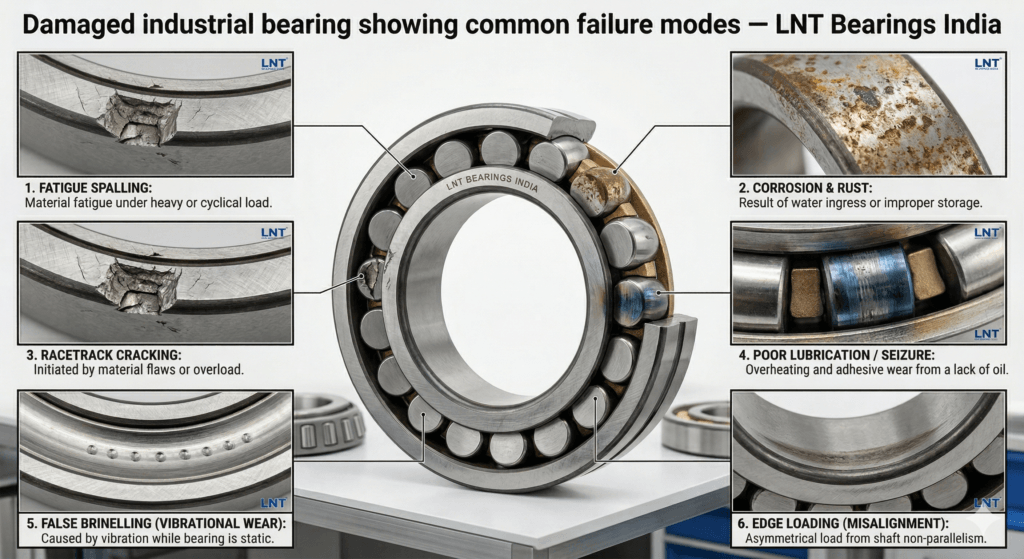
8 Reasons Bearings Fail & How to Prevent Them
Bearings are among the most critical components in any rotating machine. From two-wheelers on Indian roads to heavy industrial pumps and conveyor systems in manufacturing plants, bearings keep everything moving. However, when a bearing fails, the consequences are serious. Production lines halt, repair costs rise, and in severe cases, equipment breaks down entirely.
The good news is that most bearing failures are entirely preventable. In fact, research shows that over 80% of premature bearing failures occur due to avoidable causes — poor lubrication, contamination, misalignment, and improper installation. Therefore, understanding the root causes of bearing failure is the first and most important step in extending bearing life.
In this guide, we cover the 8 most common causes of bearing failure, the warning signs to watch for, and practical prevention strategies that maintenance teams across Indian industries can implement right away.
What Is Bearing Failure?
Bearing failure occurs when a bearing can no longer perform its intended function — supporting load and enabling smooth rotation. Although bearings are designed for long service life, they operate under demanding conditions such as high speeds, heavy loads, temperature extremes, and exposure to contaminants. Consequently, when any of these conditions exceed design limits or when maintenance is neglected, bearings may fail well before their rated service life.
Additionally, bearing failures do not always happen suddenly. In most cases, they progress through four stages — from early microscopic damage that only advanced sensors can detect, all the way to catastrophic breakdown. Therefore, catching the warning signs early is essential for preventing costly downtime.
Quick Reference: 8 Bearing Failure Causes at a Glance
| Failure Cause | Root Reason | Warning Sign | Fix |
| Improper Lubrication | Wrong type, too much, or too little grease | Overheating, squealing noise | Use correct lubricant at right intervals |
| Contamination | Dust, sand, water enters bearing | Increased vibration, pitting | Use sealed bearings, clean environment |
| Misalignment | Shaft and housing not aligned | Uneven wear, noise | Precision alignment during installation |
| Overloading | Load exceeds bearing rating | Rapid heat rise, surface fatigue | Select correct load-rated bearing |
| Improper Installation | Incorrect tools or force applied | Early damage, noise after fitting | Use bearing heaters, follow guidelines |
| Fatigue (Spalling) | Cyclic stress fractures surface | Flaking metal, rumbling noise | Replace at recommended intervals |
| Corrosion | Moisture or chemicals attack metal | Rust, pitting, discolouration | Use sealed or stainless bearings |
| Electrical Erosion | Stray current passes through bearing | Cratering on raceways | Use insulated or ceramic bearings |
1. Improper Lubrication — The Number One Culprit
Improper lubrication is, by far, the most common cause of bearing failure worldwide. In fact, studies suggest that lubrication-related problems account for up to 36% of all bearing failures. Therefore, getting lubrication right is the single highest-impact action a maintenance team can take.
Lubrication problems fall into three categories. First, under-lubrication creates metal-to-metal contact, which generates excessive friction and heat. Second, over-lubrication raises operating temperature by churning excess grease, leading to seal damage. Third, using the wrong type of lubricant — for example, applying standard grease to a high-temperature application — degrades rapidly and loses its protective film.
Furthermore, contaminated lubricant is equally dangerous. When dust, water, or metal particles mix with grease, the lubricant loses its effectiveness. As a result, abrasion damage accelerates and bearing life drops sharply.
Prevention tips:
- Use the lubricant grade and type specified by the bearing manufacturer
- Follow a fixed relubrication schedule based on speed, temperature, and load
- In India’s hot and humid conditions, check lubricant condition more frequently during summer months
- Train maintenance staff on correct greasing quantities to avoid over-greasing
2. Contamination — A Major Problem in Indian Industrial Environments
Contamination is the second leading cause of premature bearing failure, and it is particularly relevant in Indian industrial environments. Dust from construction sites, sand from coastal areas, water ingress during monsoons, and metal shavings from machining operations — all of these can enter bearing assemblies through damaged or improperly fitted seals.
Once inside, contaminants cause abrasive wear on raceways and rolling elements. Consequently, microscopic pits form on the bearing surfaces, which eventually grow into spalling and catastrophic failure. Moreover, water reacts with metal surfaces to cause rust and corrosion, further accelerating the damage.
In industries such as cement, steel, textile, and food processing — all of which are major employers in India — contamination risk is especially high. Therefore, sealed bearings with robust lip seals are strongly recommended for these environments.
Prevention tips:
- Specify sealed or shielded bearings (2RS or ZZ designations) in dusty or wet environments
- Store bearings in their original packaging in clean, dry locations before installation
- Inspect seals regularly and replace them at the first sign of wear or damage
- During monsoon season, increase inspection frequency for bearings in outdoor or semi-outdoor equipment
3. Misalignment — Small Errors With Big Consequences
Misalignment occurs when the shaft and the bearing housing are not correctly aligned during installation. Even a small angular or parallel misalignment can cause uneven load distribution across the bearing’s rolling elements. As a result, certain areas of the raceway carry far more stress than they are designed for, leading to rapid wear and early failure.
Furthermore, misalignment generates excessive vibration and heat, both of which are warning signs that are easy to detect during routine inspections. In addition to shortening bearing life, misalignment also damages seals and lubricant, creating a cascade of secondary problems.
Common causes of misalignment include bent shafts, damaged or worn housings, and incorrectly positioned locking nuts. Additionally, thermal expansion during operation can shift components, making periodic re-alignment checks essential.
Prevention tips:
- Use laser alignment tools for precision shaft and housing alignment
- Consider self-aligning ball bearings or spherical roller bearings for applications where some misalignment is unavoidable
- Check alignment after any maintenance activity or equipment shutdown
4. Overloading — Exceeding the Bearing’s Design Limits
Every bearing is designed to handle a specific range of radial and axial loads. When machines operate beyond these limits — either due to process changes, equipment modifications, or incorrect bearing selection — the bearing experiences contact stresses that exceed its capacity. Consequently, surface fatigue develops rapidly, leading to spalling and premature failure.
In Indian manufacturing environments, overloading often occurs when equipment is used for applications beyond its original design. For example, a conveyor system upgraded to carry heavier loads, or a pump running at higher pressures, may stress its bearings beyond their rated capacity. Therefore, any significant change in operating conditions requires a review of bearing specifications.
Prevention tips:
- Always select bearings with the correct dynamic load rating (C) for the application
- Review bearing specifications whenever process conditions change
- Monitor bearing temperature — a sudden rise indicates the bearing may be under excessive load
5. Improper Installation — Damage That Starts at Fitting
Improper installation is a surprisingly common cause of bearing failure, and in most cases, the damage it causes is invisible at the time of fitting. Applying fitting force to the wrong ring, using hammers instead of proper mounting tools, or failing to heat the bearing to the correct temperature before mounting — all of these mistakes create internal stresses and indentations that surface later during operation.
Furthermore, incorrect fits — where the bearing is either too tight or too loose on the shaft or in the housing — lead to shaft creep or fretting corrosion. As a result, the bearing’s geometry is compromised, and its rated life is significantly reduced.
Prevention tips:
- Always use a bearing induction heater or oil bath to heat bearings before mounting, rather than using hammers
- Apply mounting force only to the ring being fitted — inner ring for shaft fitting, outer ring for housing fitting
- Use the bearing manufacturer’s tolerance tables to verify the correct interference fit
- Train technicians on correct mounting procedures before they handle critical equipment
6. Fatigue (Spalling) — The Result of Running Past Service Life
Bearing fatigue, also known as spalling, is the natural end-of-life failure mode for a bearing that has run its full service life. However, it can also occur prematurely due to overloading, misalignment, or poor lubrication. In both cases, the mechanism is the same: cyclic stress causes sub-surface cracks to form, which gradually propagate to the surface, resulting in flaking or pitting of the raceway.
The characteristic sign of fatigue failure is a rumbling or grinding noise, accompanied by increased vibration. Therefore, regular vibration analysis is the most effective way to detect spalling in its early stages — often weeks before catastrophic failure.
Prevention tips:
- Replace bearings at manufacturer-recommended intervals, not just when they fail
- Implement vibration monitoring on critical equipment to detect fatigue early
- Address root causes — overloading or misalignment — that accelerate fatigue progression
7. Corrosion — A Particular Challenge in India’s Climate
Corrosion is a particularly relevant failure mode in India, where coastal humidity, monsoon moisture, and high ambient temperatures create ideal conditions for rust formation on bearing components. Corrosion causes pitting on raceways and rolling elements, which increases surface roughness, generates noise, and dramatically shortens bearing life.
In addition to atmospheric moisture, corrosion can result from water ingress during bearing washing, condensation inside sealed housings, or contact with process chemicals in industries such as chemical manufacturing, food processing, and pharmaceuticals. Consequently, bearing material selection is critical in these environments.
Prevention tips:
- Use stainless steel bearings in food processing, pharmaceutical, or coastal applications
- Apply anti-corrosion coatings or use VCI (Vapour Corrosion Inhibitor) packaging for stored bearings
- Ensure housings are properly sealed to prevent moisture ingress
- Avoid washing bearings with high-pressure water, which can emulsify the lubricant and allow moisture entry
8. Electrical Erosion — A Growing Issue in EV and Motor Applications
Electrical erosion, also called electrical pitting or fluting, occurs when stray electrical currents pass through the bearing instead of following their intended path through the ground connection. These currents discharge across the bearing’s rolling elements and raceways, creating thousands of tiny craters in a characteristic pattern known as fluting.
Furthermore, this failure mode is becoming increasingly common with the rise of variable frequency drives (VFDs) in Indian industry and the growth of electric vehicle manufacturing. As a result, insulated bearings or ceramic-coated bearings are now specified in many motor and EV drivetrain applications.
Prevention tips:
- Specify electrically insulated bearings (with insulated inner or outer ring) for VFD-driven motors
- Use hybrid ceramic bearings in EV motor applications
- Check grounding connections regularly to ensure current does not route through bearings
How to Detect Bearing Failure Early: Key Warning Signs
Bearing failure rarely happens without warning. In fact, most failures send clear signals well in advance — giving maintenance teams valuable time to act. Therefore, learning to recognise these warning signs is as important as understanding the root causes.
The four key warning signs are:
- Unusual noise — grinding, squealing, or rumbling sounds indicate surface damage or lubrication failure
- Excessive heat — a temperature rise of 10°C above normal operating temperature is a serious warning sign; at 20°C above normal, failure may be imminent
- Increased vibration — vibration analysis tools can detect developing faults months before failure
- Lubricant condition — discoloured, metallic-speck-laden grease signals advanced wear and should trigger immediate inspection
Bearing Failure Prevention in Indian Industries
India’s industrial base — spanning automotive, textiles, cement, steel, chemicals, and food processing — presents unique challenges for bearing maintenance. High ambient temperatures, monsoon humidity, dusty environments, and the widespread use of older equipment all increase the risk of premature bearing failure.
However, Indian industry is also increasingly adopting predictive maintenance technologies. Consequently, vibration analysers, infrared thermometers, and oil analysis kits are becoming standard tools in progressive maintenance departments. Furthermore, the shift toward Industry 4.0 practices means that continuous bearing monitoring is now accessible to mid-sized manufacturers, not just large corporates.
Additionally, choosing a reliable bearing supplier is a critical part of any prevention strategy. Counterfeit and substandard bearings are a genuine problem in the Indian market. Therefore, sourcing from verified distributors who supply genuine, certified bearings ensures that the stated load ratings and material quality are actually delivered.
Conclusion
Bearing failure is costly, but in most cases, it is preventable. The eight causes covered in this guide — improper lubrication, contamination, misalignment, overloading, improper installation, fatigue, corrosion, and electrical erosion — account for the vast majority of failures in Indian industry. Therefore, addressing even two or three of these root causes through improved maintenance practices can dramatically extend bearing life and reduce unplanned downtime.
In summary, a proactive approach — combining correct bearing selection, proper installation, scheduled lubrication, regular inspections, and predictive monitoring — is the most effective strategy for any maintenance team. Start with lubrication and contamination control, as these deliver the fastest results with the lowest investment.
Frequently Asked Questions (FAQ)
Use Rank Math’s FAQ Block to add these questions — this automatically generates FAQ schema markup for Google rich snippets.
What is the most common cause of bearing failure?
Improper lubrication is the most common cause of bearing failure, accounting for up to 36% of all cases. This includes under-lubrication, over-lubrication, and using the wrong type of lubricant for the application.
How do I know if a bearing is about to fail?
The four main warning signs of impending bearing failure are unusual noise (grinding or squealing), excessive heat, increased vibration, and discoloured or metallic-flecked lubricant. If you notice any of these, inspect the bearing immediately.
How long do industrial bearings last?
Bearing service life depends on the application, load, speed, and maintenance practices. Under ideal conditions, most bearings are designed for a rated L10 life of thousands of hours. However, poor lubrication or contamination can reduce this life by 50% or more.
What causes bearings to run hot?
Overheating in bearings is most commonly caused by over-greasing, insufficient lubricant, excessive load, misalignment, or contamination. A temperature rise of more than 10°C above normal operating temperature is a serious warning sign.
Published by LNT Bearings | blogs.lntbearings.com | Quality · Reliability · Excellence