
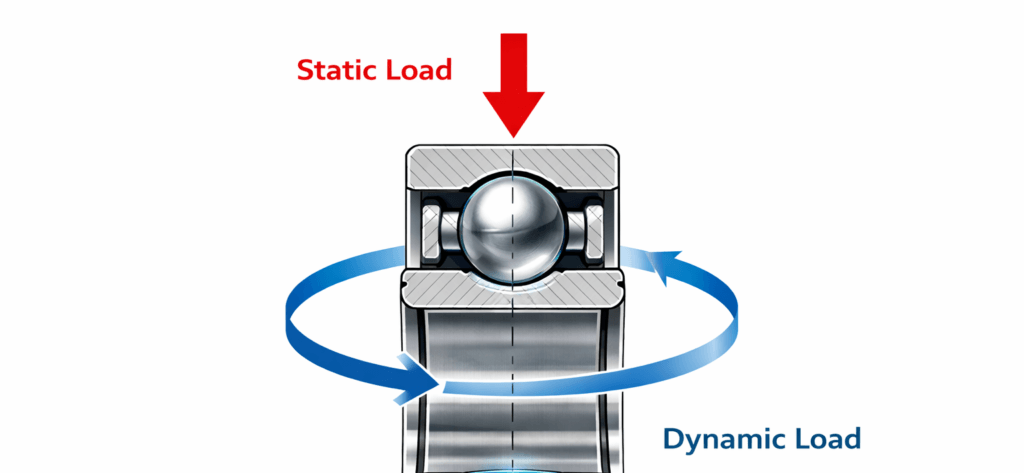
In industrial machinery, understanding bearing load ratings is essential for selecting the correct bearing and ensuring long service life. Load ratings define the amount of force a bearing can withstand while operating efficiently. Two key terms commonly used in bearing specifications are dynamic load rating and static load rating. These ratings help engineers determine whether a bearing can safely handle the loads applied during operation.
Selecting a bearing with the correct load rating improves machine reliability, performance, and durability. If the load exceeds the bearing’s capacity, it can lead to premature wear, overheating, or even complete bearing failure.
What is Dynamic Load Rating?
The dynamic load rating refers to the maximum load a bearing can carry while rotating for a specified lifespan. It is typically represented by the symbol C in bearing catalogs.
Dynamic load rating is calculated based on the load that a bearing can sustain for one million revolutions without fatigue failure. This rating is mainly used when the bearing is operating under continuous rotation.
Key points about dynamic load rating:
- Applies to bearings in motion or rotation
- Determines the expected bearing life
- Important for high-speed and continuous operations
- Expressed in kilonewtons (kN)
For example, in applications like conveyor systems, electric motors, pumps, and gearboxes, bearings experience constant rotation. In such cases, the dynamic load rating is the primary factor used when selecting the correct bearing.
What is Static Load Rating?
The static load rating, represented by the symbol C₀, indicates the maximum load a bearing can withstand when it is stationary or rotating very slowly.
This rating refers to the load that causes a small permanent deformation at the contact point between the rolling elements and the raceway. While this deformation is very small, exceeding the static load rating can lead to permanent damage in the bearing.
Key characteristics of static load rating:
- Applies when the bearing is not rotating or moving slowly
- Prevents permanent deformation of bearing components
- Important for equipment that carries heavy loads at rest
- Also expressed in kilonewtons (kN)
Static load rating is particularly important in applications such as construction equipment, cranes, heavy machinery, and industrial presses, where large loads may act on bearings even when the machine is not in motion.
Dynamic vs Static Load Rating
Understanding the difference between these two ratings helps engineers choose the right bearing for specific operating conditions.
| Feature | Dynamic Load Rating (C) | Static Load Rating (C₀) |
|---|---|---|
| Condition | Bearing in motion | Bearing stationary or slow |
| Purpose | Determines bearing life | Prevents permanent deformation |
| Application | High-speed and continuous operation | Heavy loads at rest |
| Unit | Kilonewtons (kN) | Kilonewtons (kN) |
Both ratings are provided in bearing specification tables along with dimensions, speed limits, and other technical data.
Why Load Ratings Matter
Bearing load ratings are critical for ensuring efficient and safe machine operation. Choosing a bearing with the correct dynamic and static load ratings helps:
- Extend bearing service life
- Prevent mechanical failures
- Reduce maintenance costs
- Improve overall machine performance
Engineers typically analyze radial loads, axial loads, operating speed, and environmental conditions before selecting a bearing.
Conclusion
Understanding dynamic and static load ratings is fundamental when selecting industrial bearings. Dynamic load ratings determine how a bearing performs during continuous rotation, while static load ratings indicate the maximum load a bearing can handle when stationary. Both values help ensure proper bearing selection and long-term reliability in industrial applications.
If you need to identify the correct bearing load ratings, dimensions, and specifications, you can easily use the LNT Bearings search engine to find bearing numbers and request quotes for industrial bearings.
Note: The information presented in this article is based on secondary data sources and general industry references.