
If you work in engineering, procurement, or industrial maintenance in India, you have almost certainly seen bearing numbers like 6205, 6305 2RS, or 22318 C3 stamped on a component. But do you know exactly what each digit means?
Understanding how to read a bearing number is one of the most practical skills for anyone who selects, sources, or replaces bearings. It saves time, prevents ordering errors, and ensures your machines always get the right component.
This complete guide breaks down every part of a bearing number — from the basic structure to series codes, bore sizes, and suffixes — using real examples like the 6200 series, 6300 series, and the widely used 6205 bearing.
Why Bearing Numbers Matter
Every bearing carries a number that is not just a product code. It is a compact technical specification that tells you:
- The type of bearing (ball, roller, thrust, etc.)
- The series (light-duty, medium-duty, or heavy-duty design)
- The bore size (inner diameter in millimetres)
- Any special features (sealed, shielded, increased clearance, etc.)
When you know how to read this number, you can identify a replacement bearing instantly — even if the original manufacturer’s catalogue is unavailable.
The Standard Structure of a Bearing Number
Bearing numbers follow the ISO 15:2017 international standard and consist of three main parts:
| Part | What It Tells You | Example |
|---|---|---|
| Prefix | Special design variant or material | L, K, GS |
| Basic Number | Type + Series + Bore Size | 6205 |
| Suffix | Seals, clearance, cage, tolerance | 2RS, ZZ, C3 |
The basic number is the most important part and is what most engineers refer to when identifying a bearing.
Breaking Down the Basic Bearing Number
For most common bearings — especially Deep Groove Ball Bearings — the basic number follows this pattern:
| Position | Digit(s) | What It Means |
|---|---|---|
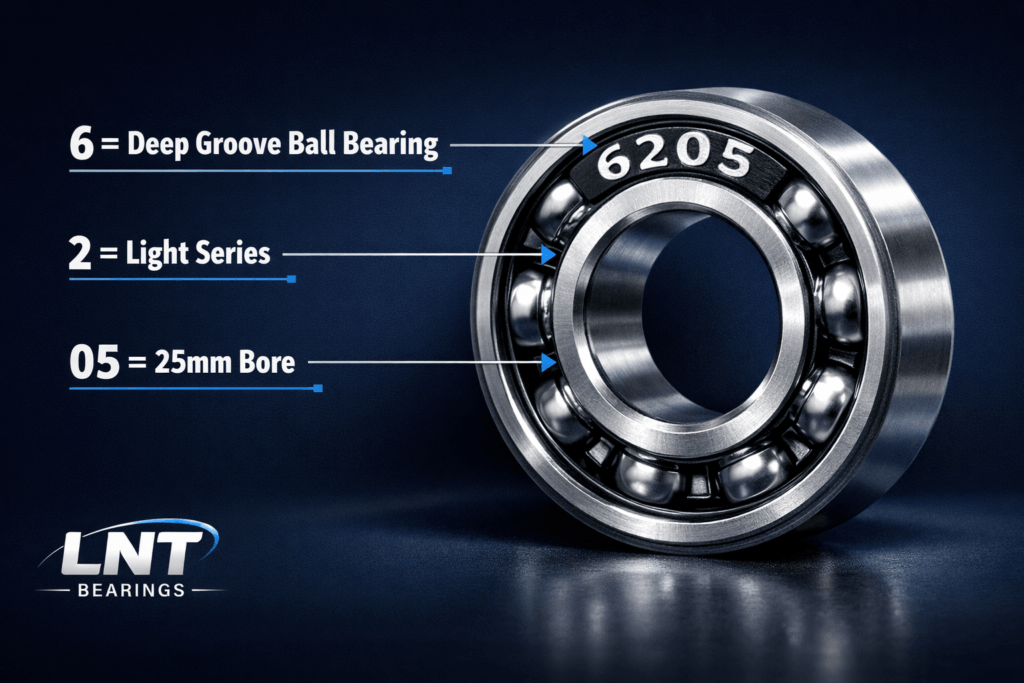
| First digit | 6 | Bearing Type → Deep Groove Ball Bearing |
| Second digit | 2 | Series Code → Light series |
| Last two digits | 05 | Bore Code → 05 × 5 = 25 mm bore |
Digit 1: Bearing Type Code
The first digit (or first two digits for some types) identifies the bearing family.
| Type Code | Bearing Type |
|---|---|
| 6 | Deep Groove Ball Bearing |
| 7 | Angular Contact Ball Bearing |
| N | Cylindrical Roller Bearing |
| NU | Cylindrical Roller Bearing (free outer ring) |
| 22 | Spherical Roller Bearing |
| 30 | Tapered Roller Bearing |
| 51 | Thrust Ball Bearing |
| 81 | Cylindrical Roller Thrust Bearing |
Quick Tip: If a bearing number starts with 6, it is a Deep Groove Ball Bearing — the most commonly used bearing type in Indian industry.
Digit 2: Series Code (The Key to Load Capacity)
The second digit — often called the series code or dimension series — defines the cross-section of the bearing: how wide and tall the outer and inner rings are relative to the bore.
A higher series number generally means a larger, heavier cross-section with greater load capacity.
| Series Code | Series Name | Description |
|---|---|---|
| 0 | Extra Light | Thinnest profile, minimal load |
| 1 | Extra Light | Slightly heavier than 0 series |
| 2 | Light | Standard light-duty series |
| 3 | Medium | Heavier cross-section, higher load |
| 4 | Heavy | Widest cross-section, highest radial load |
This is exactly why 6200 and 6300 series bearings have the same bore sizes but very different load ratings.
6200 Series vs 6300 Series — What Is the Difference?
This is one of the most common questions in bearing procurement in India. Engineers often ask: “Can I replace a 6205 with a 6305?”
The answer is No — they are not interchangeable, even though both have a 25 mm bore.
| Feature | 6200 Series (Light) | 6300 Series (Medium) |
|---|---|---|
| Series Code | 2 — Light | 3 — Medium |
| Bore Diameter | Same | Same |
| Outer Diameter | Smaller | Larger |
| Width | Narrower | Wider |
| Dynamic Load Rating | Lower | Higher |
| Static Load Rating | Lower | Higher |
| Weight | Lighter | Heavier |
| Typical Application | Motors, fans, light machinery | Pumps, gearboxes, heavier loads |
6205 vs 6305 — Direct Comparison
| Specification | 6205 | 6305 |
|---|---|---|
| Bore (d) | 25 mm | 25 mm |
| Outer Diameter (D) | 52 mm | 62 mm |
| Width (B) | 15 mm | 17 mm |
| Dynamic Load (Cr) | ~14.0 kN | ~22.5 kN |
| Static Load (C0r) | ~7.8 kN | ~11.4 kN |
As shown above, the 6305 is significantly stronger than the 6205, even though both fit a 25 mm shaft. Selecting the wrong series means the bearing will either be undersized — causing premature failure — or oversized, meaning it simply will not fit the housing.
Digits 3 and 4: Bore Code (How to Calculate Shaft Size)
The last two digits of the basic number represent the bore code, from which the bore diameter (inner diameter) of the bearing is calculated.
The x5 Rule (for bore codes 04 and above)
For bore codes 04 and above, multiply the code by 5 to get the bore diameter in millimetres.
| Bore Code | Bore Diameter |
|---|---|
| 04 | 04 × 5 = 20 mm |
| 05 | 05 × 5 = 25 mm |
| 06 | 06 × 5 = 30 mm |
| 07 | 07 × 5 = 35 mm |
| 08 | 08 × 5 = 40 mm |
| 09 | 09 × 5 = 45 mm |
| 10 | 10 × 5 = 50 mm |
| 12 | 12 × 5 = 60 mm |
| 18 | 18 × 5 = 90 mm |
Special Bore Codes — 00 to 03
These four codes do NOT follow the x5 rule. Memorise them separately:
| Bore Code | Bore Diameter |
|---|---|
| 00 | 10 mm |
| 01 | 12 mm |
| 02 | 15 mm |
| 03 | 17 mm |
Memory Tip: The four special codes give you 10, 12, 15, and 17 mm — not evenly spaced, so memorise these four specifically.
Step-by-Step: How to Read Bearing Number 6205
Let us decode 6205 completely:
- 6 → Bearing Type: Deep Groove Ball Bearing
- 2 → Series Code: Light series (standard load)
- 05 → Bore Code: 05 × 5 = 25 mm bore diameter
6205 Bearing Specs — Full Table
| Parameter | Value |
|---|---|
| Bearing Type | Deep Groove Ball Bearing |
| Bore Diameter (d) | 25 mm |
| Outer Diameter (D) | 52 mm |
| Width (B) | 15 mm |
| Dynamic Load Rating (Cr) | ~14.0 kN |
| Static Load Rating (C0r) | ~7.8 kN |
| Speed Rating (grease) | ~13,000 RPM |
| Weight | ~0.14 kg |
The 6205 bearing is one of the most widely used bearings in Indian industry. It is found in electric motors, agricultural equipment, small pumps, conveyors, and automotive components.
More Bearing Number Examples — Decoded
6300
- 6 → Bearing Type: Deep Groove Ball Bearing
- 3 → Series Code: Medium series
- 00 → Bore Code: Special code = 10 mm bore
Application: Small high-load motors, spindles
6308
- 6 → Bearing Type: Deep Groove Ball Bearing
- 3 → Series Code: Medium series
- 08 → Bore Code: 08 × 5 = 40 mm bore diameter
Application: Medium pumps, fans, gearbox input shafts
22318
- 22 → Bearing Type: Spherical Roller Bearing
- 3 → Series Code: Medium series
- 18 → Bore Code: 18 × 5 = 90 mm bore diameter
Application: Heavy-duty conveyors, industrial gearboxes, paper machines
NU 310
- NU → Bearing Type: Cylindrical Roller Bearing
- 3 → Series Code: Medium series
- 10 → Bore Code: 10 × 5 = 50 mm bore diameter
Application: Electric motors, axles, high-speed machinery
Understanding Bearing Suffixes
After the basic number, suffixes provide additional technical details about sealing, clearance, cage material, and tolerance class.
Sealing and Shielding Suffixes
| Suffix | Meaning | Best For |
|---|---|---|
| ZZ | Metal shields on both sides (non-contact) | Dry, high-speed environments |
| 2RS | Rubber seals on both sides (contact) | Dusty or wet environments |
| RS | Rubber seal on one side only | Semi-enclosed housings |
| Z | Metal shield on one side | Light contamination protection |
Example — 6205 ZZ means: Deep Groove Ball Bearing, 25 mm bore, metal shielded on both sides.
Example — 6205 2RS means: Deep Groove Ball Bearing, 25 mm bore, rubber sealed on both sides.
Procurement Tip: For Indian industrial environments — where dust, humidity, and contamination are common — 2RS sealed bearings are generally preferred over open or ZZ bearings.
Internal Clearance Suffixes
Internal clearance affects heat, noise, and load distribution.
| Suffix | Clearance Level | Use Case |
|---|---|---|
| C2 | Below normal (tight) | Precision instruments, low vibration |
| (none) | Normal — CN | Standard applications |
| C3 | Above normal (loose) | High-temperature applications, interference fits |
| C4 | Larger than C3 | Extreme heat, heavy loads |
| C5 | Largest | Specialised industrial machinery |
Example — 6205 C3 means: 6205 bearing with increased internal clearance — commonly used in electric motors that run hot.
For a detailed guide on clearance, refer to our blog: Bearing Clearance Levels Explained: C2, Normal, C3, C4, and C5 [Link: https://blogs.lntbearings.com/bearing-clearance-levels-explained-c2-normal-cn-c3-c4-and-c5-clearance-in-industrial-bearings/]
Other Common Suffixes
| Suffix | Meaning |
|---|---|
| K | Tapered bore (1:12 taper) |
| M | Brass cage |
| P6 | Tolerance class 6 — higher precision |
| P5 | Tolerance class 5 — even higher precision |
| NR | Snap ring groove on outer ring |
Reading a Full Bearing Number with Suffix
Example: 6205-2RS-C3
- 6205 → Basic Number: Deep Groove Ball Bearing, Light series, 25 mm bore
- 2RS → Rubber sealed on both sides
- C3 → Increased internal clearance
In plain English: This is a rubber-sealed Deep Groove Ball Bearing with a 25 mm bore, light series, with increased internal clearance — suitable for a motor running in a high-temperature or dusty environment.
Example: 22218 EK/C3
- 22218 → Basic Number: Spherical Roller Bearing, Series 2, 90 mm bore
- EK → Tapered bore with snap cage
- C3 → Increased internal clearance
Common Bearing Number Mistakes in Procurement
Even experienced engineers make these errors when reading bearing numbers:
Mistake 1 — Confusing 6200 and 6300 series: Both have the same bore, but the 6300 is significantly larger and stronger. The outer diameter is different. Always check the outer diameter before ordering.
Mistake 2 — Ignoring the suffix: A 6205 and a 6205 2RS will not perform the same in a dusty or wet environment. The suffix is not optional information — it is a functional specification.
Mistake 3 — Applying the x5 rule to bore codes 00 to 03: Many engineers mistakenly calculate 00, 01, 02, and 03 using the x5 rule. Remember: 00 = 10 mm, 01 = 12 mm, 02 = 15 mm, 03 = 17 mm.
Mistake 4 — Replacing with a different series without rechecking the housing: If you replace a 6205 with a 6305, the outer diameter increases from 52 mm to 62 mm. It will not fit the same housing.
Quick Reference: 6200 and 6300 Series Bore Size Chart
| Bearing Number | Series | Bore (d) | OD (D) | Width (B) |
|---|---|---|---|---|
| 6200 | Light | 10 mm | 30 mm | 9 mm |
| 6201 | Light | 12 mm | 32 mm | 10 mm |
| 6202 | Light | 15 mm | 35 mm | 11 mm |
| 6203 | Light | 17 mm | 40 mm | 12 mm |
| 6204 | Light | 20 mm | 47 mm | 14 mm |
| 6205 | Light | 25 mm | 52 mm | 15 mm |
| 6206 | Light | 30 mm | 62 mm | 16 mm |
| 6207 | Light | 35 mm | 72 mm | 17 mm |
| 6208 | Light | 40 mm | 80 mm | 18 mm |
| 6209 | Light | 45 mm | 85 mm | 19 mm |
| 6210 | Light | 50 mm | 90 mm | 20 mm |
| 6300 | Medium | 10 mm | 35 mm | 11 mm |
| 6301 | Medium | 12 mm | 37 mm | 12 mm |
| 6302 | Medium | 15 mm | 42 mm | 13 mm |
| 6303 | Medium | 17 mm | 47 mm | 14 mm |
| 6304 | Medium | 20 mm | 52 mm | 15 mm |
| 6305 | Medium | 25 mm | 62 mm | 17 mm |
| 6306 | Medium | 30 mm | 72 mm | 19 mm |
| 6307 | Medium | 35 mm | 80 mm | 21 mm |
| 6308 | Medium | 40 mm | 90 mm | 23 mm |
| 6309 | Medium | 45 mm | 100 mm | 25 mm |
| 6310 | Medium | 50 mm | 110 mm | 27 mm |
Bearing Number vs Bearing Part Number — What Is the Difference?
The bearing number (following ISO standards) is different from a manufacturer’s internal part number or catalogue code.
For example, LNT Bearings supplies bearings that conform to ISO standards. A bearing labelled 6205 from LNT Bearings is dimensionally interchangeable with any other manufacturer’s 6205 bearing worldwide — as long as the suffix also matches.
This interchangeability is one of the biggest advantages of the ISO bearing numbering system. It makes procurement, replacement, and maintenance far easier across different brands and suppliers.
Applications by Bearing Series
| Series | Typical Industries in India | Common Machines |
|---|---|---|
| 6200 — Light | Textile, FMCG, Electronics | Fans, small motors, conveyors |
| 6300 — Medium | Pumps, Agriculture, Automotive | Water pumps, tractors, compressors |
| 6400 — Heavy | Mining, Heavy Engineering | Heavy conveyors, crushers |
| 22000 — Spherical | Steel, Cement, Paper | Industrial gearboxes, rolling mills |
| 30000 — Tapered | Automotive, Railways | Wheel hubs, axleboxes, gearboxes |
| N/NU — Cylindrical | Machine Tools, Power | Spindles, high-speed motors |
Summary: How to Read a Bearing Number in 4 Steps
Step 1 — Identify the Type Code (first digit or two): This tells you the bearing family — ball, cylindrical, spherical, tapered, or thrust.
Step 2 — Identify the Series Code (second digit): This tells you the cross-section and load capacity — light (2), medium (3), or heavy (4).
Step 3 — Read the Bore Code (last two digits): Multiply by 5 if the code is 04 or above to get the bore diameter in mm. For 00 to 03, use the special values: 10, 12, 15, 17 mm.
Step 4 — Read the Suffix: This identifies seals (2RS, ZZ), clearance (C3), cage material (M), and tolerance class (P5, P6).
Conclusion
Reading a bearing number is a fundamental skill in mechanical engineering and industrial procurement. Once you understand the structure — type code, series code, bore code, and suffix — every bearing number becomes instantly readable.
The 6205 bearing alone tells you: Deep Groove Ball Bearing, Light series, 25 mm bore — a specification that matches millions of machines across India. Knowing the difference between 6200 series and 6300 series, and understanding suffixes like 2RS and C3, ensures that you always select the right bearing and avoid costly errors.
Whether you are an engineer designing a new machine, a procurement manager placing a bulk order, or a maintenance technician replacing a worn component, understanding bearing number meaning will always serve you well.
Data Sources and Disclaimer
The specifications and data provided in this article are based on standard ISO bearing dimensions and publicly available engineering references. Actual bearing specifications may vary slightly depending on manufacturer tolerances. Always verify dimensions against the manufacturer’s current catalogue before finalising procurement.
Need Help Identifying or Sourcing a Bearing?
LNT Bearings supplies a wide range of Deep Groove Ball Bearings, Spherical Roller Bearings, Cylindrical Roller Bearings, and more — across Delhi, NCR, and PAN India.
Website: www.lntbearings.com Email: info@lntindia.co.in Phone: +91-9560025418
Use our Advanced Bearing Search Engine to find the exact bearing number you need, check availability, and request a quote instantly.
RELATED ARTICLES