India’s manufacturing sector is expanding rapidly, and the demand for industrial bearings is growing along with it. Bearings play a critical role in almost every rotating machine, from automotive engines and electric motors to steel plant equipment and wind turbines.
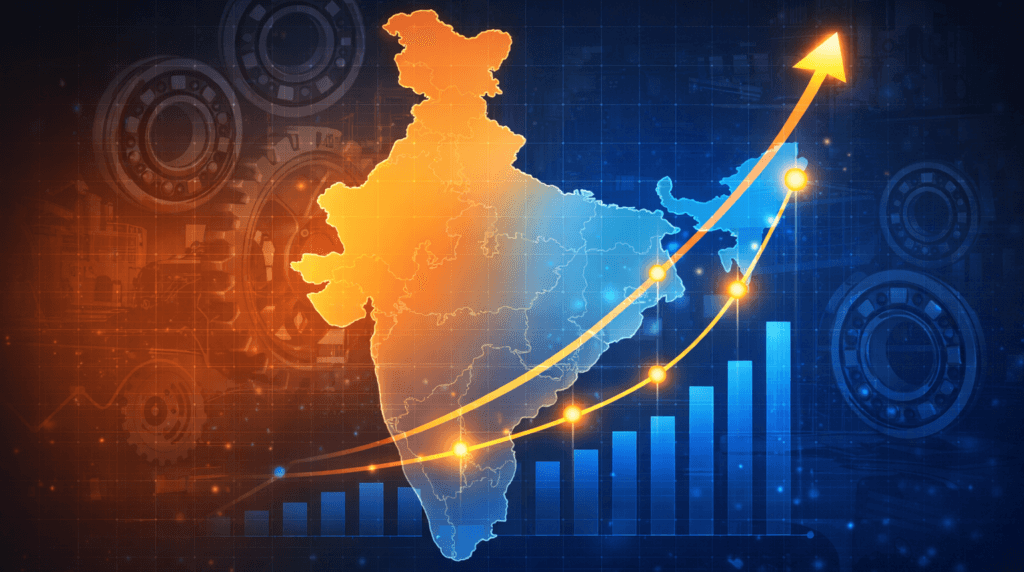
According to industry market research reports, the India bearings market was valued at approximately USD 5.2 billion in 2025 and is projected to reach nearly USD 12 billion by 2034, growing at a compound annual growth rate (CAGR) of around 9–10%.
This strong growth is driven by industrial expansion, infrastructure development, and increasing automation across sectors.
What Is Driving the Growth of the Bearings Market?
Several factors are contributing to the rapid growth of the bearings industry in India.
Growth of the Automotive Sector
India is one of the largest automobile producers in the world. According to the Society of Indian Automobile Manufacturers (SIAM), the country produced over 25 million vehicles in FY2023.
Each vehicle contains dozens of bearings used in:
- Engines
- Gearboxes
- Wheels
- Alternators
- Steering systems
Therefore, the expansion of automotive manufacturing directly increases the demand for high-quality bearings.
Expansion of Infrastructure and Construction
India’s infrastructure sector is growing quickly due to government initiatives such as:
- Make in India
- National Infrastructure Pipeline
- Smart Cities Mission
As a result, demand for construction equipment is increasing. Machinery such as excavators, cranes, and concrete mixers all rely heavily on durable industrial bearings.
Industrial Automation and Manufacturing
Automation is transforming factories across India. Modern equipment uses precision bearings in:
- CNC machines
- Robotics systems
- Conveyor systems
- Packaging machinery
Consequently, industries require high-performance bearings that can operate reliably under continuous production conditions.
Renewable Energy Growth
The renewable energy sector is another major driver of bearing demand. Wind turbines, for example, require specialized bearings for their gearboxes and main shafts.
According to the International Energy Agency (IEA), India is expected to significantly expand its renewable energy capacity in the coming decade. As a result, the demand for large and high-performance bearings will continue to increase.
Emerging Trends in the Bearings Industry
As technology evolves, several new trends are shaping the future of bearings.
Smart Bearings and Predictive Maintenance
Modern industrial systems are adopting smart bearings equipped with sensors that monitor:
- Temperature
- Vibration
- Speed
- Load
These sensors allow predictive maintenance, which helps companies detect problems before machine failure occurs.
High Temperature and Specialty Bearings
Industries such as steel plants and cement manufacturing require bearings that can withstand extreme heat and heavy loads. Therefore, demand for high-temperature and specialty bearings is increasing.
These bearings are designed using advanced materials and special lubrication systems to operate in harsh environments.
Electric Vehicle (EV) Growth
Electric vehicles require precision bearings in motors, transmissions, and drivetrain systems.
According to industry forecasts, India’s EV market is expected to grow rapidly over the next decade. As a result, the demand for high-performance bearings designed for electric mobility is expected to rise significantly.
Industries Driving Bearing Demand in India
Several sectors contribute significantly to bearing consumption.
Automotive Manufacturing
The automotive industry remains the largest consumer of bearings. Bearings are used in multiple vehicle systems that require smooth and reliable rotation.
Steel and Heavy Industry
Steel plants use large spherical and cylindrical roller bearings in rolling mills, crushers, and heavy machinery.
Mining and Cement
Mining equipment operates under extreme conditions and requires robust bearings that can withstand shock loads and contamination.
Agriculture Machinery
Tractors, harvesters, and irrigation equipment all use bearings to support rotating shafts and moving components.
Future Outlook of the Bearings Market
Industry experts expect the bearings market in India to grow steadily over the next decade. Several factors support this positive outlook.
First, manufacturing output in India continues to increase. Second, infrastructure development is accelerating across the country. Finally, technological advancements in machinery are increasing the demand for precision components such as bearings.
Because of these developments, the bearings industry will remain an essential part of India’s industrial growth.
Conclusion
Bearings are fundamental components in modern machinery. As industries expand and technology advances, the demand for reliable and high-performance bearings will continue to grow.
India’s strong manufacturing growth, infrastructure development, and renewable energy expansion are all contributing to the rising demand for bearings.
Businesses that stay informed about industry trends will be better prepared to meet future market needs.
Need Industrial Bearings for Your Application?
For genuine bearing solutions and technical guidance:
🌐 www.lntindia.co.in
✉ info@lntbearings.com
📞 +91-9560025418
Supplying reliable bearing solutions across Delhi, NCR & PAN India.
Data Sources and Disclaimer
The market statistics, industry trends, and projections mentioned in this article are based on secondary research data collected from publicly available industry reports, government publications, and market analysis sources such as the International Energy Agency (IEA), Society of Indian Automobile Manufacturers (SIAM), and various global market research reports.
These figures are intended for general informational purposes to provide an overview of the bearings industry and its growth trends. Actual market conditions may vary depending on economic factors, industry developments, and regional demand.