Introduction
Linear bearings are a critical component in modern engineering, enabling smooth, precise motion in a straight line. Unlike conventional rotary bearings that support rotational movement, linear bearings are designed to reduce friction and guide motion along a linear axis.
From CNC machines to electric vehicles and robotics, linear bearings are becoming increasingly important as industries move toward automation, precision, and high-speed performance.
What is a Linear Bearing?
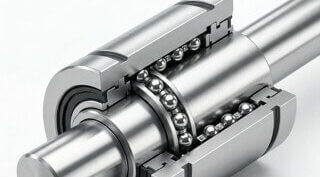
A linear bearing is a mechanical component that allows free motion in one direction while restricting movement in other directions. It typically works along a shaft, rail, or guide system, using rolling elements like balls or rollers to minimize friction.
Key Features:
- Low friction linear motion
- High precision and repeatability
- Load-bearing capability (radial & sometimes moment loads)
- Suitable for high-speed applications
Types of Linear Bearings
1. Ball Bushing Linear Bearings
These are the most common type of linear bearings.
How they work:
They use recirculating balls inside the bearing to provide smooth motion along a hardened shaft.
Advantages:
- Low friction
- High speed capability
- Cost-effective
Applications:
- 3D printers
- Packaging machines
- Light automation systems
2. Linear Guide Rails (Profile Rail Bearings)
These are high-precision linear motion systems consisting of a rail and a carriage (block).
How they work:
Rolling elements move between the rail and carriage, ensuring high rigidity and accuracy.
Advantages:
- High load capacity
- Excellent rigidity
- Precise positioning
Applications:
- CNC machines
- Robotics
- Semiconductor equipment
3. Roller Linear Bearings
Instead of balls, these bearings use rollers, which provide a larger contact area.
Advantages:
- Higher load capacity than ball bearings
- Greater stiffness
- Better shock resistance
Applications:
- Heavy machinery
- Industrial automation
- Aerospace systems
4. Plain (Sliding) Linear Bearings
These operate without rolling elements and rely on sliding contact surfaces.
Advantages:
- Maintenance-free
- Corrosion-resistant
- Quiet operation
Applications:
- Food processing equipment
- Medical devices
- Dusty or dirty environments
5. Magnetic Linear Bearings
These use magnetic levitation to eliminate physical contact.
Advantages:
- Zero friction
- No wear and tear
- Ultra-high precision
Applications:
- High-speed transport systems
- Semiconductor manufacturing
- Advanced research systems
Key Applications of Linear Bearings
1. Industrial Automation
Linear bearings are widely used in automated production lines for:
- Pick-and-place systems
- Conveyor systems
- Assembly machines
2. CNC & Machine Tools
They ensure:
- High precision cutting
- Smooth tool movement
- Reduced vibration
3. Electric Vehicles (EVs)
With the rise of EVs, linear bearings are used in:
- Battery assembly systems
- Automated manufacturing lines
- Motor assembly processes
4. Robotics
Essential for:
- Linear actuators
- Robotic arms
- Precision positioning
5. Medical Equipment
Used in:
- MRI machines
- Surgical robots
- Diagnostic devices
Advantages of Linear Bearings
- High Precision: Ideal for applications requiring accuracy
- Low Friction: Improves efficiency and lifespan
- Versatility: Suitable for multiple industries
- Scalability: Available for both light and heavy-duty applications
Future of Linear Bearings
Linear bearings are set to become one of the most widely used bearing technologies due to:
- Growth in automation and Industry 4.0
- Increasing demand for electric vehicles
- Expansion of robotics and AI-driven manufacturing
- Need for compact and efficient mechanical systems
They are no longer just components—they are enablers of precision engineering and future mobility.
Conclusion
Linear bearings play a vital role in modern machinery by enabling smooth, accurate, and efficient linear motion. Whether it’s a simple 3D printer or a complex robotic system, the right type of linear bearing ensures performance, reliability, and longevity.
As industries continue evolving, linear bearings will remain at the core of innovation, powering everything from factory automation to next-generation transportation systems.
📞 Get in Touch – LNT Bearings
At LNT Bearings, we provide high-quality linear bearings designed for precision and durability across industries.
🌐 Website: www.lmtbearings.com
📧 Email: info@lntindia.co.in | info@lntbearings.com
📱 Phone: 9560025418 | 9810466117