Deep groove ball bearings are one of the most widely used types of bearings in modern machinery. They are known for their simple design, smooth performance, and high-speed capability. Because of these advantages, they are commonly used in motors, pumps, fans, automotive parts, and many industrial machines.
In addition, these bearings are easy to maintain and relatively cost-effective. Therefore, they are often the first choice for many engineers and equipment manufacturers.
This article explains how deep groove ball bearings work, their main features, and where they are used.
What are Deep Groove Ball Bearings?
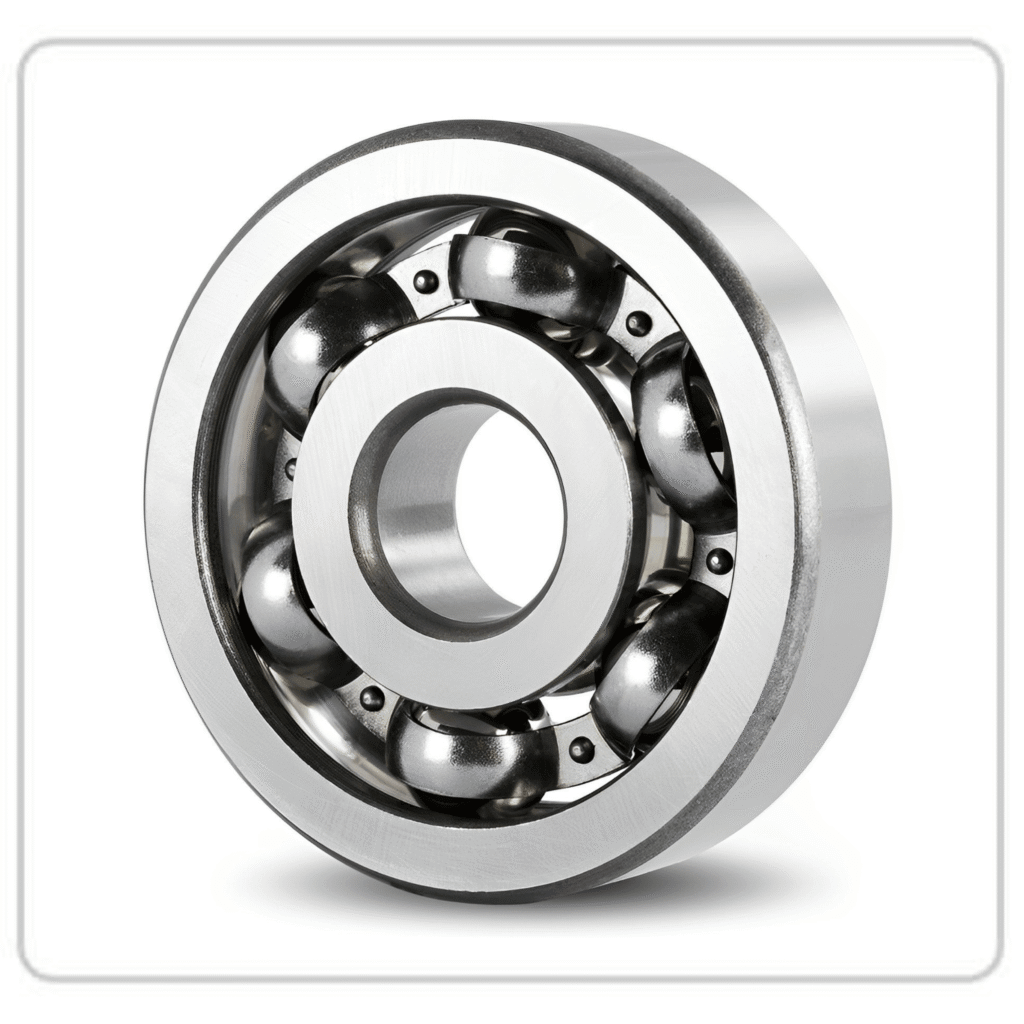
A deep groove ball bearing is a rolling-element bearing that contains balls between two rings. The raceways on both the inner and outer rings are designed with deep grooves. As a result, the balls move smoothly while supporting the load.
Typically, these bearings consist of:
- Inner ring
- Outer ring
- Steel balls
- Cage (separator)
Because of this structure, the bearing can support radial loads and moderate axial loads. Moreover, it operates with very low friction.
Key Features of Deep Groove Ball Bearings
Several features make these bearings popular across industries.
First, they support high rotational speeds. In addition, the friction between the balls and raceways is very low. As a result, machines operate more efficiently.
Another advantage is their simple design. Because of this, installation and maintenance are easier compared to many other bearing types.
Important features include:
✔ High-speed capability
✔ Low friction operation
✔ Quiet and smooth performance
✔ Long service life
✔ Low maintenance requirements
For these reasons, deep groove ball bearings are widely used in both small machines and heavy industrial equipment.
Types of Deep Groove Ball Bearings
Different variants are available depending on the application.
Open Bearings
Open bearings do not contain seals or shields. Therefore, they require external lubrication. However, they are suitable for environments where contamination is minimal.
Shielded Bearings (ZZ)
These bearings include metal shields on both sides. As a result, dust and debris are prevented from entering the bearing.
Sealed Bearings (2RS)
Sealed bearings use rubber seals instead of metal shields. Consequently, they provide better protection against moisture and contaminants.
Single Row Bearings
Single-row bearings are the most common type. They are used in many standard industrial applications.
Double Row Bearings
Double-row designs offer higher load capacity. Therefore, they are suitable for heavier machinery.
Applications of Deep Groove Ball Bearings
Deep groove ball bearings are used in many industries. Their versatility makes them suitable for a wide range of machines.
Electric Motors
First of all, these bearings are commonly used in electric motors. They support high speeds while maintaining smooth operation.
Automotive Industry
In vehicles, deep groove ball bearings are used in alternators, gearboxes, and wheels. Consequently, they play an important role in vehicle performance.
Industrial Machinery
Many industrial machines rely on these bearings. For example, they are used in pumps, compressors, and conveyor systems.
Agricultural Equipment
Farm machinery also uses deep groove ball bearings. These bearings support rotating shafts in tractors, harvesters, and other equipment.
Household Appliances
In addition, appliances such as washing machines and air conditioners use these bearings.
Advantages of Deep Groove Ball Bearings
Deep groove ball bearings provide several important benefits.
First, they are highly reliable. In addition, their design allows smooth and quiet operation. As a result, they reduce vibration in machines.
Another benefit is their cost efficiency. Compared to other bearing types, they are often more affordable.
Key advantages include:
- Smooth operation
- Low noise and vibration
- High rotational speed
- Long service life
- Cost-effective solution
Therefore, they are widely preferred in many industries.
Deep Groove Ball Bearings vs Roller Bearings
Although both types are widely used, they serve different purposes.
| Feature | Deep Groove Ball Bearings | Roller Bearings |
|---|---|---|
| Speed Capability | High | Moderate |
| Load Capacity | Moderate | High |
| Friction | Low | Higher |
| Typical Use | Motors and machinery | Heavy equipment |
In general, ball bearings are better for high-speed applications. On the other hand, roller bearings are preferred for very heavy loads.
How to Select the Right Bearing
Selecting the correct bearing is important for machine performance. Therefore, several factors must be considered.
For example:
- Shaft diameter
- Load requirements
- Speed (RPM)
- Operating temperature
- Environmental conditions
- Lubrication method
By evaluating these factors, engineers can choose the most suitable bearing.
Common Causes of Bearing Failure
Even high-quality bearings can fail if they are not used properly. However, most failures can be prevented.
Common causes include:
- Insufficient lubrication
- Contamination from dust or moisture
- Incorrect installation
- Excessive load
Therefore, regular inspection and proper maintenance are essential.
Conclusion
Deep groove ball bearings remain one of the most important components in modern machinery. Their simple design, high-speed capability, and reliability make them suitable for a wide range of applications.
Furthermore, proper selection and maintenance can significantly extend bearing life. As a result, machines operate more efficiently and downtime is reduced.
Need Deep Groove Ball Bearings?
For genuine industrial bearings and technical assistance:
🌐 www.lntindia.co.in
✉ info@lntbearings.com
📞 +91-9560025418
Supplying reliable bearing solutions across Delhi, NCR & PAN India.
Pingback: How to Read a Bearing Number: Complete Guide (6000, 6200, 6300 Series) -