Spherical roller bearings are widely used in heavy industrial machinery. They are designed to handle very high radial loads and moderate axial loads. Because of their special design, they can also accommodate shaft misalignment.
In many industries, machines operate under difficult conditions such as vibration, shock loads, and heavy pressure. Therefore, engineers often choose spherical roller bearings for their durability and reliability.
This article explains how spherical roller bearings work, their key features, and where they are commonly used.
What are Spherical Roller Bearings?
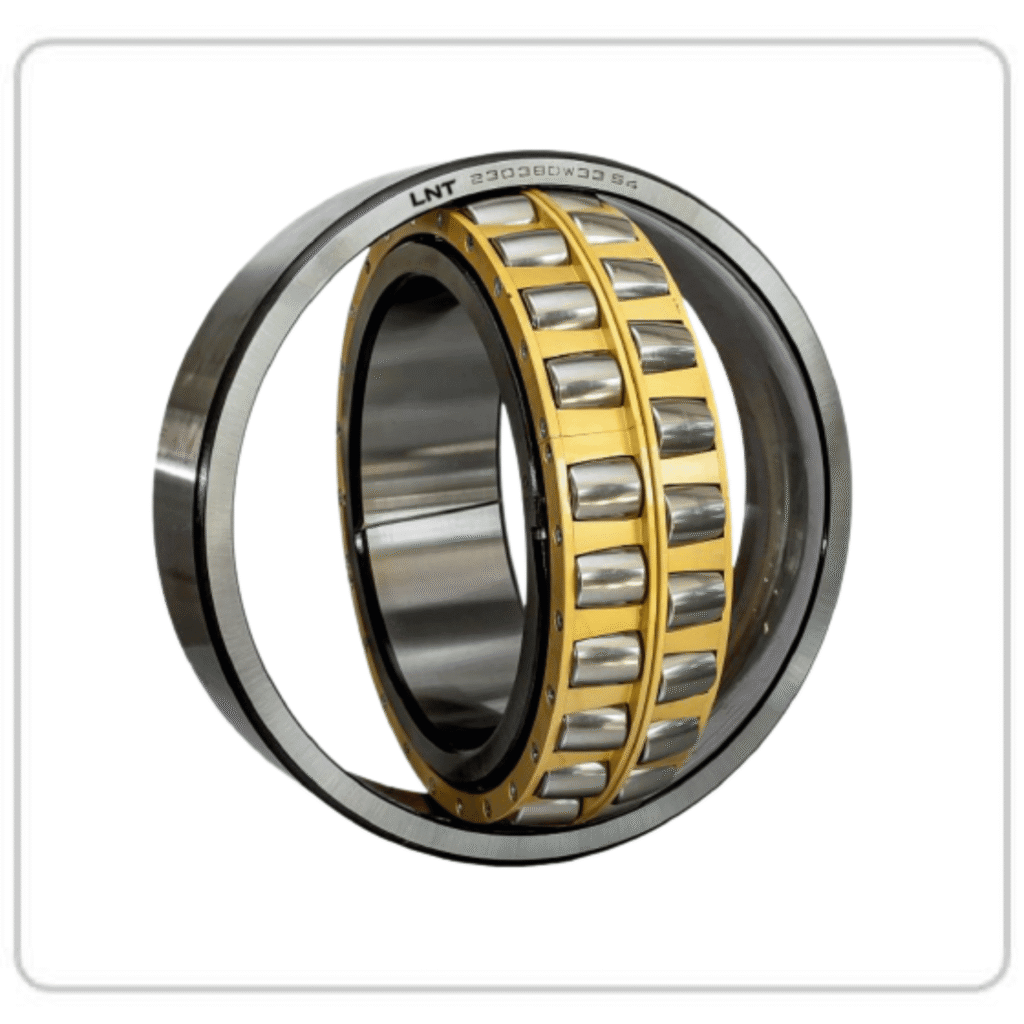
A spherical roller bearing contains two rows of barrel-shaped rollers placed between the inner and outer rings. The outer ring has a spherical raceway, which allows the bearing to adjust automatically when the shaft becomes misaligned.
Typically, the bearing consists of:
- Inner ring
- Outer ring
- Two rows of rollers
- Cage to guide the rollers
Because of this structure, the bearing can support heavy loads while maintaining smooth rotation.
Key Features of Spherical Roller Bearings
Several features make spherical roller bearings ideal for demanding applications.
First, they can support very high radial loads. In addition, they can also carry axial loads in both directions. As a result, they perform well in heavy machinery.
Another important feature is their self-aligning capability. If the shaft bends slightly or becomes misaligned, the bearing adjusts automatically. Consequently, this reduces stress and increases bearing life.
Important features include:
✔ High radial load capacity
✔ Ability to handle axial loads
✔ Self-aligning design
✔ Excellent shock resistance
✔ Reliable performance in harsh environments
Because of these advantages, spherical roller bearings are commonly used in large industrial equipment.
Types of Spherical Roller Bearings
Different types are available depending on application requirements.
Standard Spherical Roller Bearings
These are the most common type. They are used in many heavy-duty machines.
Sealed Spherical Roller Bearings
Sealed versions provide better protection against dust and contamination. Therefore, they are suitable for harsh industrial environments.
Tapered Bore Bearings
These bearings have a tapered inner bore. As a result, they are easier to mount using adapter sleeves.
Selecting the correct type depends on load conditions and installation requirements.
Applications of Spherical Roller Bearings
Spherical roller bearings are used in industries where machines experience heavy loads and vibrations.
Steel Plants
In steel manufacturing, these bearings are used in rolling mills, furnaces, and continuous casting machines. Because of the extreme loads involved, durable bearings are essential.
Mining Industry
Mining equipment such as crushers, conveyors, and vibrating screens rely heavily on spherical roller bearings. In addition, these machines operate under dusty and harsh conditions.
Cement Industry
Cement plants use these bearings in rotary kilns, grinding mills, and heavy conveyors.
Construction Machinery
Excavators, loaders, and earthmoving equipment also use spherical roller bearings because of their strength and reliability.
Advantages of Spherical Roller Bearings
Spherical roller bearings offer several important benefits.
First, they provide excellent load capacity. In addition, they perform well under shock loads and vibrations.
Another advantage is their ability to handle misalignment. Consequently, this reduces the risk of premature bearing failure.
Key advantages include:
- High durability
- Reduced maintenance requirements
- Reliable performance under heavy loads
- Longer service life
- Improved machine efficiency
Therefore, they are widely used in demanding industrial environments.
Spherical Roller Bearings vs Ball Bearings
Although both types are common, they serve different purposes.
| Feature | Spherical Roller Bearings | Ball Bearings |
|---|---|---|
| Radial Load Capacity | Very High | Moderate |
| Axial Load Capacity | Moderate | Moderate |
| Shock Resistance | Excellent | Lower |
| Speed Capability | Moderate | High |
In general, spherical roller bearings are better for heavy-duty equipment, while ball bearings are used in high-speed applications.
How to Select the Right Spherical Roller Bearing
Choosing the correct bearing requires careful evaluation.
For example, consider the following factors:
- Load requirements
- Shaft diameter
- Operating speed
- Temperature conditions
- Misalignment possibility
- Environmental contamination
By analyzing these factors, engineers can select the most suitable bearing for their machines.
Common Causes of Bearing Failure
Even strong bearings can fail if they are not used correctly. However, most failures can be prevented.
Common causes include:
- Poor lubrication
- Dust or contamination
- Incorrect installation
- Excessive load
Therefore, proper maintenance and inspection are essential for long bearing life.
Conclusion
Spherical roller bearings are essential components in heavy industrial machinery. Their ability to support high loads, handle misalignment, and resist shock makes them ideal for demanding environments.
Furthermore, proper selection and maintenance can significantly improve machine reliability and reduce downtime.
Need Spherical Roller Bearings?
For genuine industrial bearings and technical assistance:
🌐 www.lntindia.co.in
✉ info@lntbearings.com
📞 +91-9560025418
Supplying reliable bearing solutions across Delhi, NCR & PAN India.