Tapered roller bearings are widely used in machines that experience combined radial and axial loads. Unlike ball bearings, these bearings use tapered rollers that run between tapered raceways. Because of this design, the load is distributed across a larger contact area.
As a result, tapered roller bearings provide excellent strength and durability. Therefore, they are commonly used in automotive hubs, gearboxes, heavy machinery, and construction equipment.
This article explains the design, features, and applications of tapered roller bearings.
What are Tapered Roller Bearings?
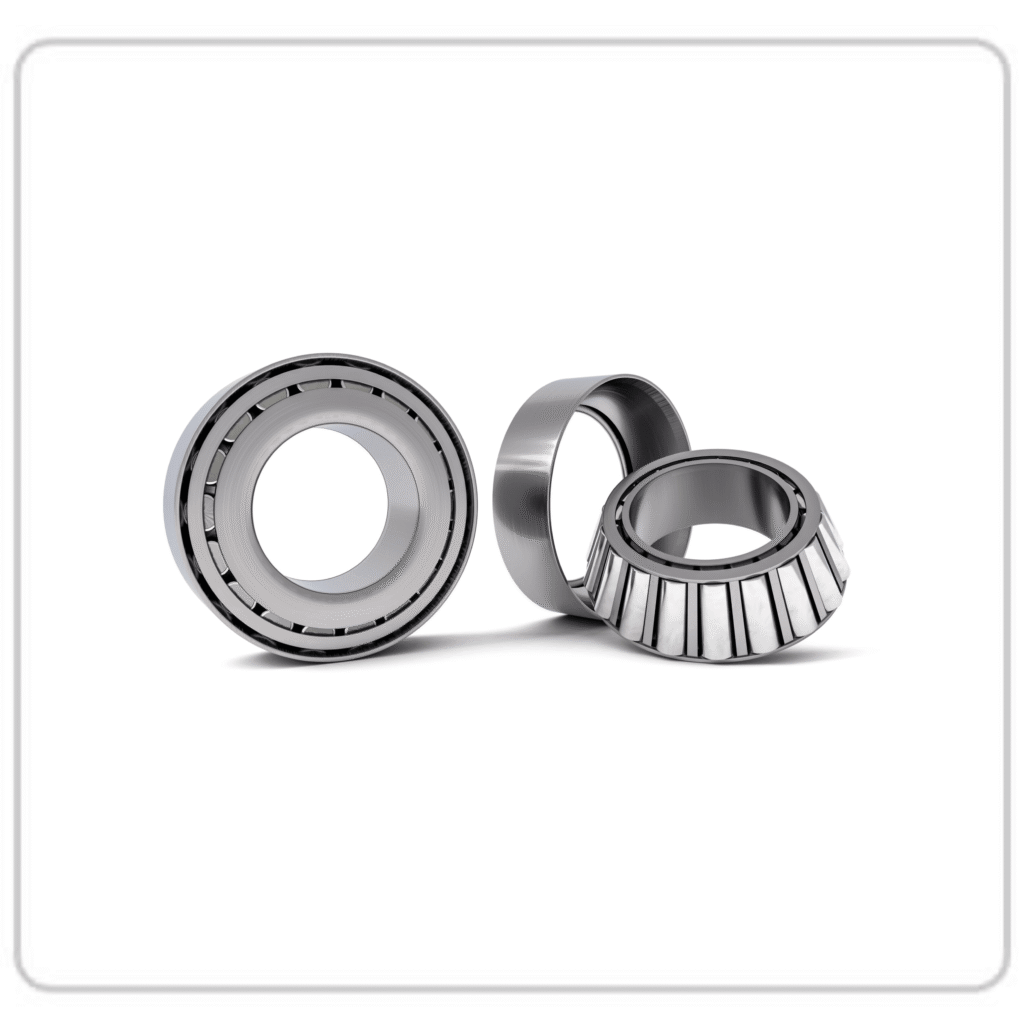
A tapered roller bearing is a rolling-element bearing that uses conical rollers placed between the inner and outer rings. Both the raceways and rollers are tapered. Because of this geometry, the rolling elements meet at a common point on the bearing axis.
Typically, the bearing consists of:
- Inner ring (cone)
- Outer ring (cup)
- Tapered rollers
- Cage to guide the rollers
Due to this arrangement, tapered roller bearings can support radial loads and axial loads simultaneously.
Key Features of Tapered Roller Bearings
Several features make tapered roller bearings suitable for demanding applications.
First, they provide excellent combined load capacity. In addition, they offer strong resistance to shock and vibration.
Another important advantage is their rigid structure, which helps maintain proper shaft alignment in heavy machinery.
Key features include:
✔ High radial and axial load capacity
✔ Strong resistance to shock loads
✔ Durable and rigid construction
✔ Long service life
✔ Reliable performance in heavy equipment
Because of these characteristics, tapered roller bearings are widely used in mechanical systems that experience heavy forces.
Types of Tapered Roller Bearings
Different configurations are available depending on load and application.
Single Row Tapered Roller Bearings
Single-row bearings are the most common type. However, they typically support axial load in only one direction. Therefore, they are often installed in pairs.
Double Row Tapered Roller Bearings
Double-row bearings provide greater load capacity and improved rigidity. As a result, they are used in heavy machinery and industrial equipment.
Four Row Tapered Roller Bearings
Four-row bearings are designed for extremely heavy loads. Consequently, they are commonly used in steel rolling mills and large industrial systems.
Selecting the correct type depends on the machine design and load requirements.
Applications of Tapered Roller Bearings
Because of their strength, tapered roller bearings are used in many industries.
Automotive Industry
These bearings are commonly found in wheel hubs, transmissions, and differentials. As a result, they play an important role in vehicle performance.
Industrial Gearboxes
Gearboxes often experience combined loads. Therefore, tapered roller bearings are used to maintain stability and reduce wear.
Construction Equipment
Excavators, loaders, and earthmoving machines rely on tapered roller bearings for durability under heavy stress.
Steel and Heavy Machinery
In heavy industrial environments, these bearings provide reliable performance even under high load conditions.
Advantages of Tapered Roller Bearings
Tapered roller bearings provide several important advantages.
First, they support combined loads effectively. In addition, their design distributes the load across a larger surface area.
Another benefit is their long service life. Because the load is evenly distributed, wear is reduced.
Major advantages include:
- High load capacity
- Strong shock resistance
- Reliable operation in heavy equipment
- Improved machine stability
- Longer bearing life
Consequently, they are widely used in demanding mechanical applications.
Tapered Roller Bearings vs Ball Bearings
Although both types are widely used, they serve different purposes.
| Feature | Tapered Roller Bearings | Ball Bearings |
|---|---|---|
| Radial Load Capacity | High | Moderate |
| Axial Load Capacity | High | Moderate |
| Shock Resistance | Good | Lower |
| Speed Capability | Moderate | High |
In general, tapered roller bearings are preferred for heavy combined loads, while ball bearings are better suited for high-speed applications.
How to Select the Right Tapered Roller Bearing
Choosing the correct bearing is important for reliable performance.
When selecting a bearing, consider:
- Load type (radial and axial)
- Shaft diameter
- Operating speed
- Temperature conditions
- Lubrication method
- Installation arrangement
By evaluating these factors, engineers can ensure proper bearing selection.
Common Causes of Bearing Failure
Even strong bearings can fail if they are not maintained properly.
Common causes include:
- Improper lubrication
- Contamination from dust or debris
- Incorrect installation
- Excessive load
Therefore, regular inspection and proper maintenance are essential.
Conclusion
Tapered roller bearings are essential components in many industrial machines. Their ability to support combined loads and resist shock makes them ideal for heavy-duty applications.
Furthermore, proper installation and maintenance can significantly increase bearing life and improve machine reliability.
Need Tapered Roller Bearings?
For genuine industrial bearings and technical assistance:
🌐 www.lntindia.co.in
✉ info@lntbearings.com
📞 +91-9560025418
Supplying reliable bearing solutions across Delhi, NCR & PAN India.