
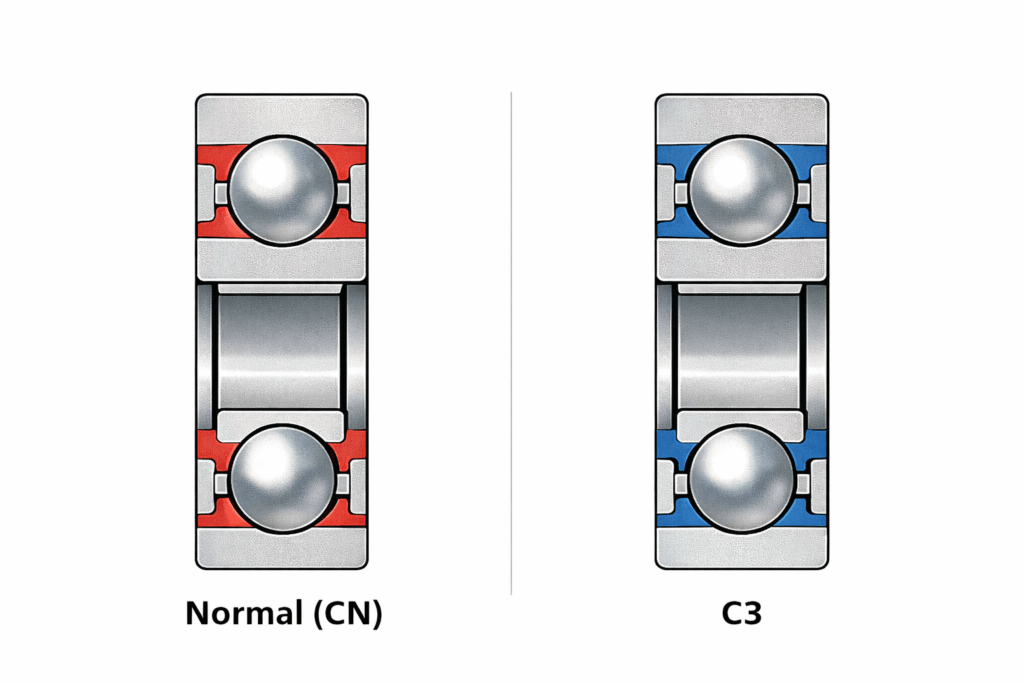
When selecting the right industrial bearing for machinery, one important factor engineers often consider is internal bearing clearance. Among the most commonly discussed options are C3 clearance bearings and Normal clearance bearings. Understanding the difference between these two is essential for ensuring optimal bearing performance, longer service life, and efficient machine operation.
Internal clearance refers to the total distance that one bearing ring can move relative to the other before the bearing is installed. This clearance affects how the bearing performs under load, temperature, and operating speed.
Therefore, choosing the correct clearance class is critical for applications such as electric motors, gearboxes, pumps, compressors, and industrial machinery.
What is Bearing Internal Clearance?
Bearing internal clearance is the amount of free movement between the rolling elements (balls or rollers) and the raceways inside the bearing before installation.
There are two types of clearance commonly discussed:
- Radial internal clearance – movement in the radial direction
- Axial internal clearance – movement along the shaft axis
Manufacturers classify internal clearance into standardized groups such as:
- C2 – Less than normal clearance
- Normal clearance (CN)
- C3 – Greater than normal clearance
- C4 and C5 – Much larger clearances for extreme conditions
Among these, Normal clearance bearings and C3 clearance bearings are the most widely used in industrial applications.
What Are Normal Clearance Bearings?
Normal clearance bearings, often denoted as CN or standard clearance bearings, are designed with a standard internal clearance suitable for general operating conditions.
These bearings are commonly used in machinery where operating temperatures, speeds, and loads remain within typical ranges.
Key Features of Normal Clearance Bearings
- Standard internal clearance level
- Suitable for normal operating temperatures
- Ideal for standard industrial applications
- Provides balanced load distribution and smooth operation
Common Applications
Normal clearance bearings are widely used in:
- Conveyor systems
- Agricultural equipment
- General industrial machinery
- Household appliances
- Low to moderate speed rotating equipment
Because of their versatility, standard clearance bearings are among the most widely used bearing types in everyday machinery.
What Are C3 Clearance Bearings?
C3 clearance bearings have greater internal clearance than normal bearings. This extra clearance helps compensate for thermal expansion, higher operating temperatures, or tight shaft fits that may reduce internal clearance during operation.
As machinery operates at high speeds or elevated temperatures, the bearing rings expand. The additional clearance in C3 bearings prevents excessive friction and overheating.
Key Features of C3 Bearings
- Greater internal clearance than standard bearings
- Suitable for high-speed applications
- Performs well in high-temperature environments
- Prevents bearing preload caused by thermal expansion
Common Applications
C3 clearance bearings are frequently used in:
- Electric motors and generators
- Industrial pumps and compressors
- High-speed rotating machinery
- Automotive applications
- Gearboxes and transmission systems
In fact, electric motor bearings often require C3 clearance due to heat generation during operation.
C3 vs Normal Clearance Bearings: Key Differences
Understanding the differences between these two clearance types helps ensure the correct bearing is selected for each application.
| Feature | Normal Clearance Bearings | C3 Clearance Bearings |
|---|---|---|
| Internal Clearance | Standard clearance | Greater than normal |
| Operating Temperature | Normal temperature conditions | High temperature environments |
| Speed Capability | Moderate speeds | High-speed applications |
| Thermal Expansion Handling | Limited | Better compensation for expansion |
| Typical Applications | General machinery | Electric motors, pumps, high-speed equipment |
When to Choose C3 Clearance Bearings
C3 clearance bearings are recommended when:
- Equipment operates at high speeds
- Machinery generates significant heat
- Bearings are mounted with tight shaft fits
- There is high rotational friction or thermal expansion
In these cases, using a normal clearance bearing may result in reduced internal clearance during operation, which can lead to overheating or premature bearing failure.
When to Choose Normal Clearance Bearings
Normal clearance bearings are suitable when:
- Operating temperatures remain stable and moderate
- Shaft and housing fits are standard
- Machinery operates at normal rotational speeds
For most general industrial machinery, standard clearance bearings provide reliable and efficient performance.
Conclusion
Understanding the difference between C3 clearance bearings and normal clearance bearings is essential for selecting the right bearing for your machinery. While normal clearance bearings are ideal for standard operating conditions, C3 bearings provide additional internal clearance that helps accommodate high speeds, thermal expansion, and demanding environments.
Selecting the correct clearance class ensures better bearing performance, reduced friction, longer service life, and improved equipment reliability.
To explore bearing numbers, dimensions, and detailed specifications, you can use the LNT Bearings search platform at www.lntbearings.com, where users can easily find the right industrial bearing and request quotes for their applications.
Note: The information presented in this article is based on secondary data sources and general industry references.
Pingback: How to Read a Bearing Number: Complete Guide (6200, 6300, 6205 Series) -