
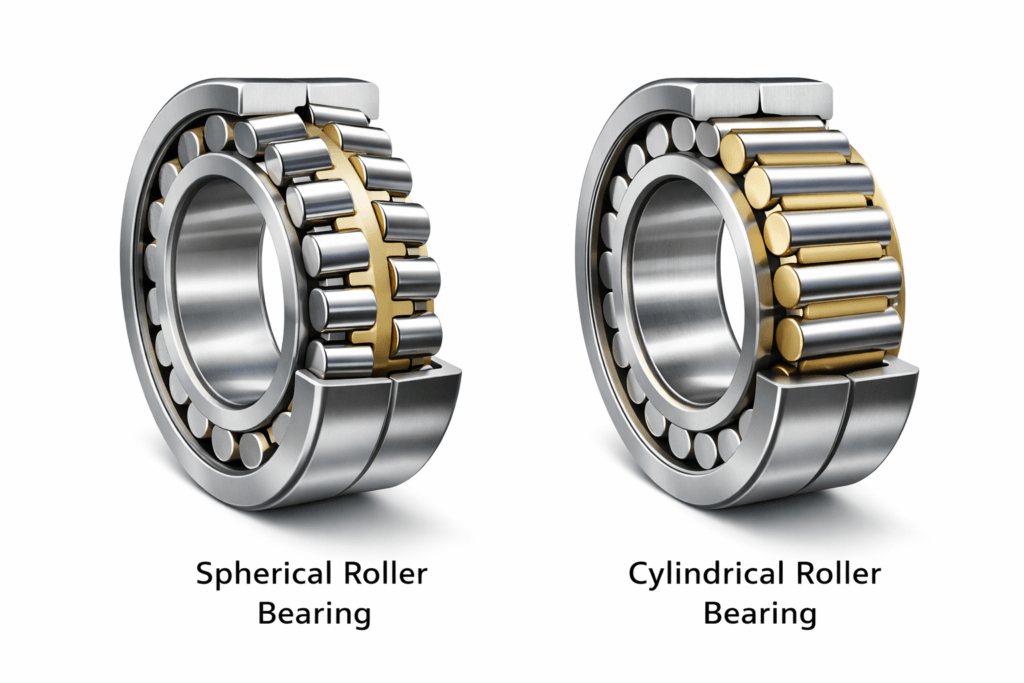
In the world of industrial bearings and heavy-duty machinery, selecting the correct bearing type is essential for ensuring high performance, long service life, and reliable machine operation. Among the most commonly used roller bearings are spherical roller bearings and cylindrical roller bearings. Both are designed to handle high radial loads, yet their internal design, performance characteristics, and ideal applications differ significantly.
Therefore, understanding the difference between spherical roller bearings vs cylindrical roller bearings helps engineers, maintenance teams, and industrial buyers choose the most suitable bearing for their machinery. In addition, selecting the correct bearing can significantly reduce machine downtime, maintenance costs, and energy losses.
What Are Spherical Roller Bearings?
Spherical roller bearings are heavy-duty self-aligning roller bearings specifically designed to accommodate shaft misalignment and heavy loads. They feature two rows of barrel-shaped rollers running on a spherical outer raceway, which allows the bearing to automatically adjust when misalignment occurs between the shaft and housing.
As a result, spherical roller bearings are widely used in industries where machinery experiences vibration, shaft deflection, or heavy shock loads.
Key features of spherical roller bearings include:
- Self-aligning design that compensates for shaft misalignment
- Very high radial load capacity
- Ability to support moderate axial loads in both directions
- Strong resistance to shock and vibration
- Suitable for harsh industrial environments
Consequently, spherical roller bearings are commonly used in heavy industrial applications such as:
- Mining equipment and crushers
- Industrial gearboxes
- Cement plants and steel mills
- Paper and pulp machinery
- Wind turbines
- Conveyor systems and material handling equipment
Because of their durability, these bearings are considered one of the most reliable heavy-load industrial bearings.
What Are Cylindrical Roller Bearings?
In contrast, cylindrical roller bearings are designed to handle very high radial loads while operating at high rotational speeds. Unlike spherical roller bearings, they contain straight cylindrical rollers that run on flat raceways.
Due to this design, cylindrical roller bearings provide excellent radial load capacity and low friction, making them ideal for high-speed machinery and precision equipment.
Important features of cylindrical roller bearings include:
- Extremely high radial load carrying capacity
- Capability to operate at high speeds
- Reduced friction between rolling elements
- Multiple design variations such as NU, NJ, NUP, and N types
- Easy mounting and dismounting in certain configurations
Therefore, cylindrical roller bearings are widely used in precision and high-speed industrial applications, including:
- Electric motors and generators
- Industrial pumps and compressors
- Machine tools
- Automotive gearboxes and transmissions
- Power generation equipment
Because of their high-speed performance, they are often used in electric motor bearings and high-speed rotating machinery.
Key Differences Between Spherical Roller Bearings and Cylindrical Roller Bearings
Although both belong to the roller bearing family, their design and functionality vary in several ways.
| Feature | Spherical Roller Bearings | Cylindrical Roller Bearings |
|---|---|---|
| Roller Shape | Barrel-shaped rollers | Straight cylindrical rollers |
| Alignment Capability | Self-aligning | Requires precise alignment |
| Load Capacity | High radial and moderate axial loads | Extremely high radial loads |
| Speed Capability | Moderate speed | High-speed operation |
| Typical Applications | Heavy-duty machinery | High-speed precision equipment |
As shown above, the main difference lies in alignment capability and speed performance.
When to Use Spherical Roller Bearings
Spherical roller bearings are the best choice when machinery operates under heavy loads and difficult conditions. For instance, if there is shaft misalignment, vibration, or heavy impact loads, these bearings provide reliable performance.
In addition, industries such as mining, construction, and material handling frequently rely on spherical roller bearings due to their robust design and durability.
When to Use Cylindrical Roller Bearings
On the other hand, cylindrical roller bearings are ideal for applications requiring high rotational speeds and high radial load capacity. For example, they are commonly used in electric motors, machine tools, and precision industrial equipment.
Since these bearings do not compensate for misalignment, they are best used in systems where shaft alignment can be carefully controlled.
Final Thoughts
To summarize, both spherical roller bearings and cylindrical roller bearings are critical components in modern industrial machinery. While spherical roller bearings excel in heavy-duty, misaligned, and shock-load applications, cylindrical roller bearings provide superior performance in high-speed and precision machinery.
Ultimately, selecting the correct bearing depends on factors such as load conditions, operating speed, alignment requirements, and the working environment.
If you want to quickly find bearing dimensions, specifications, and bearing numbers, you can use the LNT Bearings search engine to identify the right industrial bearing, roller bearing, or motor bearing and request quotes instantly.
Note: The information presented in this article is based on secondary data sources and general industry references.