Cylindrical roller bearings are widely used in machines that require high radial load capacity and reliable performance. Unlike ball bearings, these bearings use cylindrical rollers instead of balls. As a result, they provide a larger contact surface between the rollers and raceways.
Because of this design, cylindrical roller bearings can support heavier loads. In addition, they operate efficiently at relatively high speeds. Therefore, they are commonly used in electric motors, gearboxes, compressors, and industrial equipment.
This article explains how cylindrical roller bearings work, their types, and where they are used.
What are Cylindrical Roller Bearings?
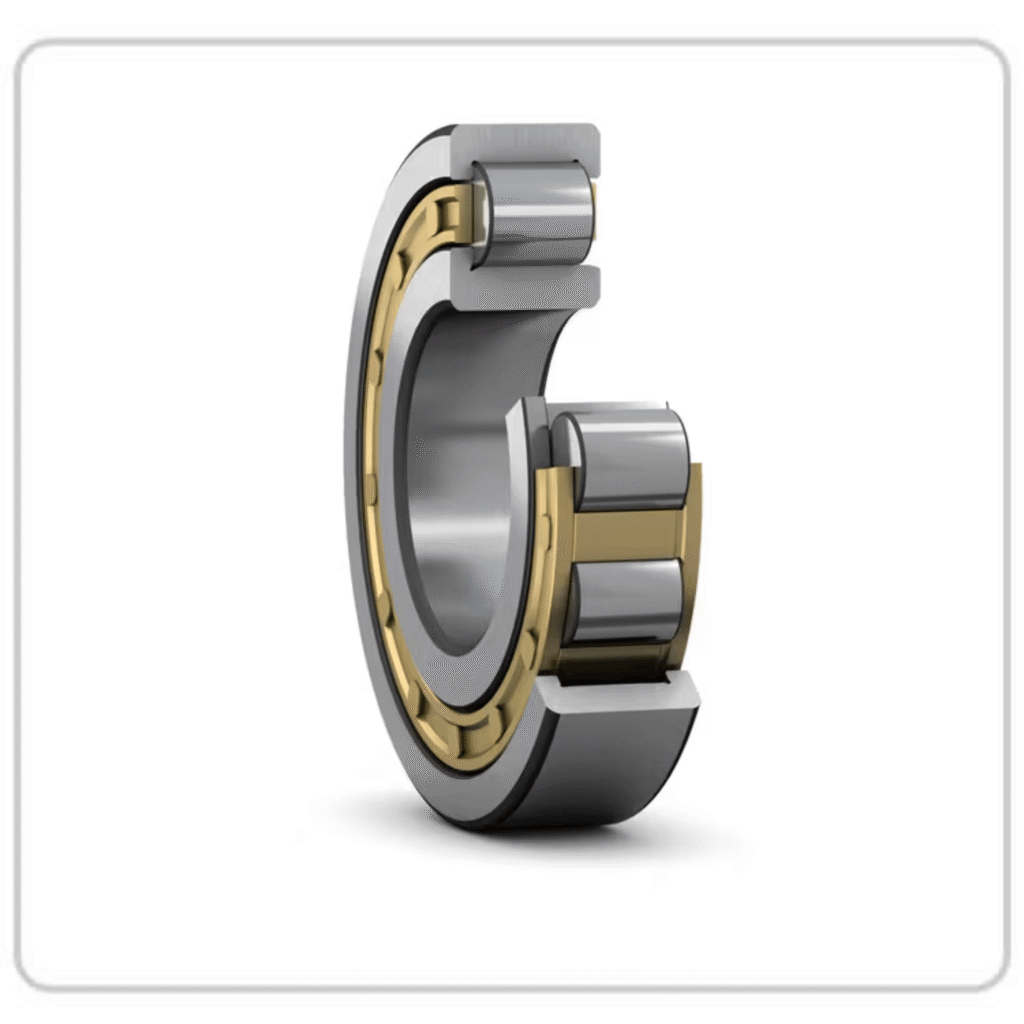
A cylindrical roller bearing is a rolling-element bearing that uses cylindrical rollers instead of balls. These rollers maintain line contact with the raceways, which allows the bearing to support higher loads.
Typically, a cylindrical roller bearing consists of:
- Inner ring
- Outer ring
- Cylindrical rollers
- Cage to guide the rollers
Because of the roller design, these bearings mainly support radial loads. However, certain types can also handle limited axial loads.
Key Features of Cylindrical Roller Bearings
Several features make cylindrical roller bearings suitable for industrial machinery.
First, they provide high radial load capacity. As a result, they are commonly used in heavy-duty equipment.
Second, these bearings can operate at relatively high speeds. In addition, the friction between components is relatively low.
Another advantage is their rigid design, which improves shaft stability.
Important features include:
✔ High radial load capacity
✔ Suitable for high-speed applications
✔ Low friction operation
✔ Durable and reliable design
✔ Easy installation and maintenance
Because of these advantages, cylindrical roller bearings are widely used in many industries.
Types of Cylindrical Roller Bearings
Different designs are available depending on load direction and mounting requirements.
NU Type Bearings
In NU-type bearings, the outer ring has two flanges while the inner ring has none. Therefore, the shaft can move axially within the bearing.
NJ Type Bearings
NJ-type bearings include flanges that allow the bearing to support axial load in one direction.
NUP Type Bearings
These bearings can support axial loads in both directions. As a result, they are suitable for locating bearing positions.
Double Row Cylindrical Roller Bearings
Double-row bearings provide higher load capacity. Consequently, they are often used in heavy industrial machinery.
Selecting the correct type depends on load conditions and shaft arrangement.
Applications of Cylindrical Roller Bearings
Cylindrical roller bearings are used in many industrial sectors because of their strength and durability.
Electric Motors
Many electric motors use cylindrical roller bearings to support radial loads while maintaining high rotational speed.
Industrial Gearboxes
In gearboxes, these bearings help maintain shaft alignment and support heavy loads.
Steel Industry
Steel plants often use cylindrical roller bearings in rolling mills and heavy machinery.
Power Generation Equipment
Generators and turbines also rely on cylindrical roller bearings for reliable performance.
Because of their load capacity, these bearings are essential in many heavy industrial systems.
Advantages of Cylindrical Roller Bearings
Cylindrical roller bearings offer several important benefits.
First, they support higher radial loads compared to ball bearings. In addition, they provide improved rigidity for rotating shafts.
Another advantage is their efficient high-speed performance. As a result, machines operate smoothly and efficiently.
Key benefits include:
- High load capacity
- Long service life
- High-speed capability
- Improved shaft stability
- Reliable industrial performance
Therefore, they are widely used in demanding mechanical systems.
Cylindrical Roller Bearings vs Ball Bearings
Although both bearings are widely used, their functions differ.
| Feature | Cylindrical Roller Bearings | Ball Bearings |
|---|---|---|
| Radial Load Capacity | High | Moderate |
| Axial Load Capacity | Limited | Moderate |
| Speed Capability | High | Very High |
| Typical Applications | Heavy machinery | High-speed equipment |
In general, cylindrical roller bearings are better for heavy radial loads, while ball bearings are preferred for very high-speed applications.
How to Select the Right Cylindrical Roller Bearing
Choosing the correct bearing requires careful evaluation.
Important factors include:
- Shaft diameter
- Radial load requirements
- Operating speed
- Temperature conditions
- Mounting arrangement
- Lubrication method
By considering these factors, engineers can ensure reliable bearing performance.
Common Causes of Bearing Failure
Even strong bearings can fail if maintenance is poor. However, most failures can be prevented.
Common causes include:
- Insufficient lubrication
- Contamination from dust or particles
- Incorrect installation
- Excessive load
Therefore, regular maintenance and proper installation are essential.
Conclusion
Cylindrical roller bearings are essential components in many industrial machines. Their ability to support heavy radial loads and operate at high speeds makes them suitable for demanding applications.
Furthermore, selecting the correct bearing and maintaining proper lubrication can significantly increase machine reliability and lifespan.
Need Cylindrical Roller Bearings?
For genuine industrial bearings and technical support:
🌐 www.lntindia.co.in
✉ info@lntbearings.com
📞 +91-9560025418
Supplying reliable bearing solutions across Delhi, NCR & PAN India.