
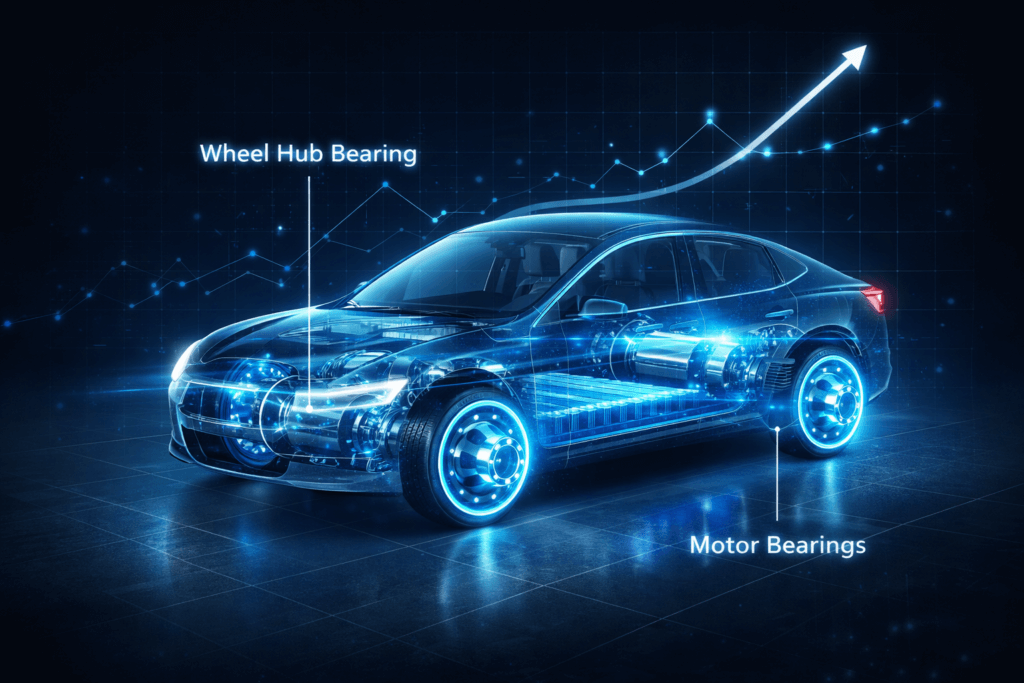
The electric vehicle (EV) industry is growing rapidly across the world. As a result, the demand for automotive bearings and precision bearings is rising at an unprecedented rate. India, in particular, is accelerating its shift to clean mobility. The government’s FAME scheme, PLI incentives, and rising fuel costs are all driving EV adoption. Consequently, Indian OEMs and bearing manufacturers are facing a major new opportunity.
Unlike conventional ICE vehicles, electric vehicles rely almost entirely on electric motors, e-axles, and advanced drivetrain systems. Therefore, these systems need specialised bearings. Standard bearings, for example, cannot handle the high speeds, electrical currents, or low-noise requirements of EV motors. In short, a new class of precision bearing is essential for the EV era.
In this article, we cover the key bearing types used in EVs, India’s growing role in the EV bearing market, and the technical requirements every engineer should know. Furthermore, we include the latest market data to help procurement teams and OEM partners make informed decisions.
EV Market Growth and Rising Bearing Demand in India
India’s EV market is expanding at a remarkable pace. In 2024, India sold over 1.6 million electric vehicles. Two-wheelers — from brands like Ola Electric, Ather, TVS iQube, and Hero Vida — lead this growth. In addition, four-wheelers from Tata, Mahindra, and MG are gaining strong traction. The government’s FAME-II scheme disbursed over ₹10,000 crore in subsidies. As a result, EV production volumes are rising sharply, and so is the demand for automotive-grade bearings.
Globally, the EV bearing market stood at $5.27 billion in 2023. Furthermore, it is projected to reach $64.73 billion by 2033 at a CAGR of 32.14%. Asia Pacific — especially China and India — will hold more than 54% of this market by 2032. Therefore, Indian bearing suppliers are in an excellent position to capture a significant share of this demand.
Every major EV subsystem depends on precision bearings. Specifically, smooth rotation, low friction, and efficient power transmission all rely on correctly specified bearings. The following components, for instance, each require a different bearing type:
- Electric traction motors
- E-axles and drivetrains
- Wheel hubs
- Transmission and reduction gear systems
- Cooling fans and auxiliary systems
- Electric two-wheeler and three-wheeler hub motors (especially relevant in India)
Types of Bearings Used in Electric Vehicles and E-Axles
Electric vehicles use several specialised bearing types. Each type serves a specific function in the drivetrain. Therefore, engineers must select bearings carefully based on speed, load, space, and electrical requirements.
1. Deep Groove Ball Bearings
Deep groove ball bearings are the most common bearing type in EV motors. Engineers choose them because they handle high rotational speeds at very low friction. In India, for example, DGBB series 6200 and 6300 bearings are popular in hub motors for electric two-wheelers. Moreover, they are easy to source, cost-effective, and available in sealed variants that need no relubrication.
2. Angular Contact Ball Bearings
Angular contact bearings handle radial and axial loads at the same time. Consequently, engineers use them in EV powertrains, reduction gearboxes, and e-axle assemblies. During acceleration and braking, loads act in multiple directions. Therefore, angular contact bearings are the preferred choice for these dynamic conditions.
3. Cylindrical Roller Bearings
Cylindrical roller bearings provide high radial load capacity. Their line-contact design distributes loads across a larger area. As a result, engineers use them in high-torque EV applications like electric buses and commercial trucks. Furthermore, they perform reliably in electric motor shafts where radial forces are dominant.
4. Needle Roller Bearings
Needle roller bearings offer high load capacity in a very compact space. For this reason, engineers use them in electric two-wheelers, gearboxes, and auxiliary motor assemblies across India. In addition, their slim profile makes them ideal wherever space is limited but load demands remain high.
5. Ceramic Hybrid Bearings
Ceramic hybrid bearings use steel rings with silicon nitride rolling elements. They are lighter, harder, and electrically non-conductive compared to all-steel bearings. As a result, they are ideal for high-performance EV motors. Furthermore, they generate less heat at high speeds and last significantly longer. Although they cost more upfront, they reduce total lifecycle costs in premium EV applications.
Technical Requirements: Speed, Insulation and NVH in EV Bearings
EV bearings must meet far stricter requirements than standard industrial bearings. Specifically, they must perform reliably across five critical performance areas:
1. High-speed capability: EV motors typically spin at 10,000–20,000 RPM. Therefore, bearings must sustain high-speed operation with minimal heat generation. Standard bearings, by contrast, are not rated for these conditions.
2. Low friction and energy efficiency: In an EV, every watt of energy lost to bearing friction directly reduces driving range. Consequently, low-friction greases, optimised internal geometry, and surface coatings are essential design requirements.
3. Electrical insulation: EV motors generate stray shaft currents. If unaddressed, these currents pass through bearings and cause pitting — a phenomenon known as fluting. Therefore, engineers specify insulated bearings with ceramic coatings, or ceramic hybrid bearings, to prevent this damage.
4. Reduced NVH (Noise, Vibration, Harshness): Because EVs produce no engine noise, bearing noise becomes immediately noticeable to the driver. As a result, EV bearings require tighter tolerances (P5 or P6 precision class), special grease formulations, and optimised raceway geometry for ultra-quiet operation.
5. Thermal resistance: EV motor temperatures spike rapidly under heavy loads. Therefore, bearings must perform across a wide thermal range. High-temperature greases and heat-stabilised steel are, consequently, standard requirements for EV motor bearings.
India EV Bearing Market: A Major Opportunity for Domestic Manufacturers
India’s bearing industry is at an inflection point. The country added 29.52 GW of renewable energy capacity in 2024–25. Furthermore, EV production is expected to reach 10 million units annually by 2030 across all vehicle segments. Therefore, domestic demand for precision EV bearings will grow substantially in the coming years.
Several key trends are shaping this India-specific opportunity. Understanding them helps engineers and procurement teams plan ahead:
- Electric two-wheelers make up over 90% of India’s EV market. Consequently, hub motor bearings for this segment represent the highest volume opportunity for bearing suppliers.
- Tata Motors, Mahindra, and JSW MG are scaling four-wheeler EV production. Therefore, demand for angular contact and cylindrical roller bearings in e-axle assemblies is rising sharply.
- Electric three-wheelers — including e-rickshaws and cargo EVs — are a uniquely Indian EV category. As a result, they create consistent bearing demand for wheel hubs and motor assemblies.
- India’s PLI scheme is attracting global EV manufacturers. Consequently, these companies need India-certified bearing suppliers within their local supply chains.
- Indian bearing manufacturers are investing in EV-specific R&D. For example, they are developing low-noise hub motor bearings, insulated motor bearings, and ceramic hybrid variants.
This shift means procurement teams at Indian EV manufacturers increasingly need bearing suppliers who understand EV-specific requirements. In other words, off-the-shelf catalogue bearings are no longer sufficient. Technical support on selection, lubrication, clearance class, and tolerance specification is, therefore, a key differentiator for bearing suppliers in this market.
EV Bearing Market Data at a Glance
| Metric | Value | Note |
| Global EV bearing market (2023) | $5.27 Billion | Base year value |
| Projected market size (2033) | $64.73 Billion | 10-year forecast |
| Market CAGR (2024–2033) | 32.14% | Fastest growing segment |
| EV motor bearing market (2025) | $4.05 Billion | Motor segment only |
| Asia Pacific market share (2032) | >54% | China + India dominant |
| India EV sales (2024) | 1.6M+ units | Fastest growing globally |
| Bearing value per EV vs ICE | ~40% higher | Per unit value |
| Global EV production (2030 forecast) | 30M+ units/year | All segments |
Source: Industry market research reports, SIAM, SMEV, and secondary trade data. All figures are approximate and for reference only.
Future Outlook: EV Bearing Demand 2026–2030
The EV industry will continue to grow strongly through 2030. As a result, demand for automotive bearings, high-speed bearings, and precision industrial bearings will grow in parallel. Furthermore, bearing manufacturers are investing heavily in R&D to create lighter, more efficient, and longer-lasting solutions specifically for EV applications.
Several emerging technologies will shape EV bearing development over the next five years. Specifically, the following innovations are already in development:
- Integrated bearing-sensor units that deliver real-time temperature, speed, and load data to the vehicle’s control system
- Grease-for-life sealed bearings that eliminate relubrication in EV motor applications entirely
- DLC (diamond-like carbon) coatings that reduce friction further and extend bearing service life
- Modular e-axle bearing units pre-assembled for direct integration into powertrain assemblies
- Lightweight aluminium-steel hybrid housings that reduce unsprung mass in electric vehicles
Beyond passenger vehicles, electric buses, electric two-wheelers, and electric commercial vehicles are expanding the market for specialised bearings in India. Consequently, bearing suppliers who invest in EV-specific capabilities today will be best positioned to serve this growing demand tomorrow.
Frequently Asked Questions: EV Bearings
Q: What bearings are used in electric vehicles?
A: Electric vehicles primarily use deep groove ball bearings, angular contact ball bearings, cylindrical roller bearings, needle roller bearings, and ceramic hybrid bearings. However, the specific type depends on the application — for example, motor shafts, e-axles, wheel hubs, or transmission systems each require a different bearing.
Q: Why do EVs need special bearings?
A: EV motors spin at 10,000–20,000 RPM — much faster than ICE engines. Furthermore, they generate electrical shaft currents that damage standard bearings through a process called fluting. In addition, because EVs are quiet, bearing noise is immediately noticeable. Therefore, EV bearings need electrical insulation, higher precision grades, and low-noise grease.
Q: What is a ceramic hybrid bearing and why is it used in EVs?
A: A ceramic hybrid bearing uses steel rings with silicon nitride (ceramic) rolling elements. As a result, it is lighter, electrically non-conductive, and generates less heat at high speeds. Consequently, engineers use ceramic hybrid bearings in EV motors where insulation and high-speed performance are critical.
Q: How does EV growth affect the bearing industry in India?
A: India’s EV boom is creating growing demand for hub motor bearings, e-axle bearings, and insulated motor bearings. Furthermore, OEMs like Tata, Mahindra, Ola, and Ather need locally sourced, certified bearings. As a result, Indian bearing manufacturers have a significant opportunity to serve this fast-growing domestic market.
Q: What bearing clearance is best for EV motor applications?
A: For most EV motor applications, C3 internal clearance is recommended over standard CN (Normal) clearance. This is because EV motors run hotter and faster than ICE motors. Therefore, C3 clearance provides additional internal space to accommodate thermal expansion and prevent preloading during operation.
Conclusion
The growth of the electric vehicle industry in India and globally is creating major new opportunities in the bearing market. As EV production rises across two-wheelers, three-wheelers, passenger cars, and commercial vehicles, the demand for high-performance automotive bearings, EV motor bearings, and precision roller bearings will increase significantly.
For engineers and procurement teams, choosing the right bearing type, clearance class, and insulation specification is critical. Specifically, it determines motor efficiency, drivetrain reliability, and overall vehicle range. Therefore, early investment in understanding EV bearing requirements pays dividends in reduced downtime and longer component life.
To find the right bearing for your EV application, explore the LNT Bearings search engine. You can identify compatible bearings by specification, check availability, and request a quote directly — all in one place.
| Related Articles on LNT Bearings Blog • Deep Groove Ball Bearings — Types, Specifications and Applications • Cylindrical Roller Bearings — High Radial Load Performance Guide • Needle Roller Bearings — Compact Design for Space-Constrained Applications • India Bearings Market Growth — Industry Trends and Forecast |
Note: The information in this article draws from secondary data sources and general industry references. Market figures are approximate and for indicative purposes only.